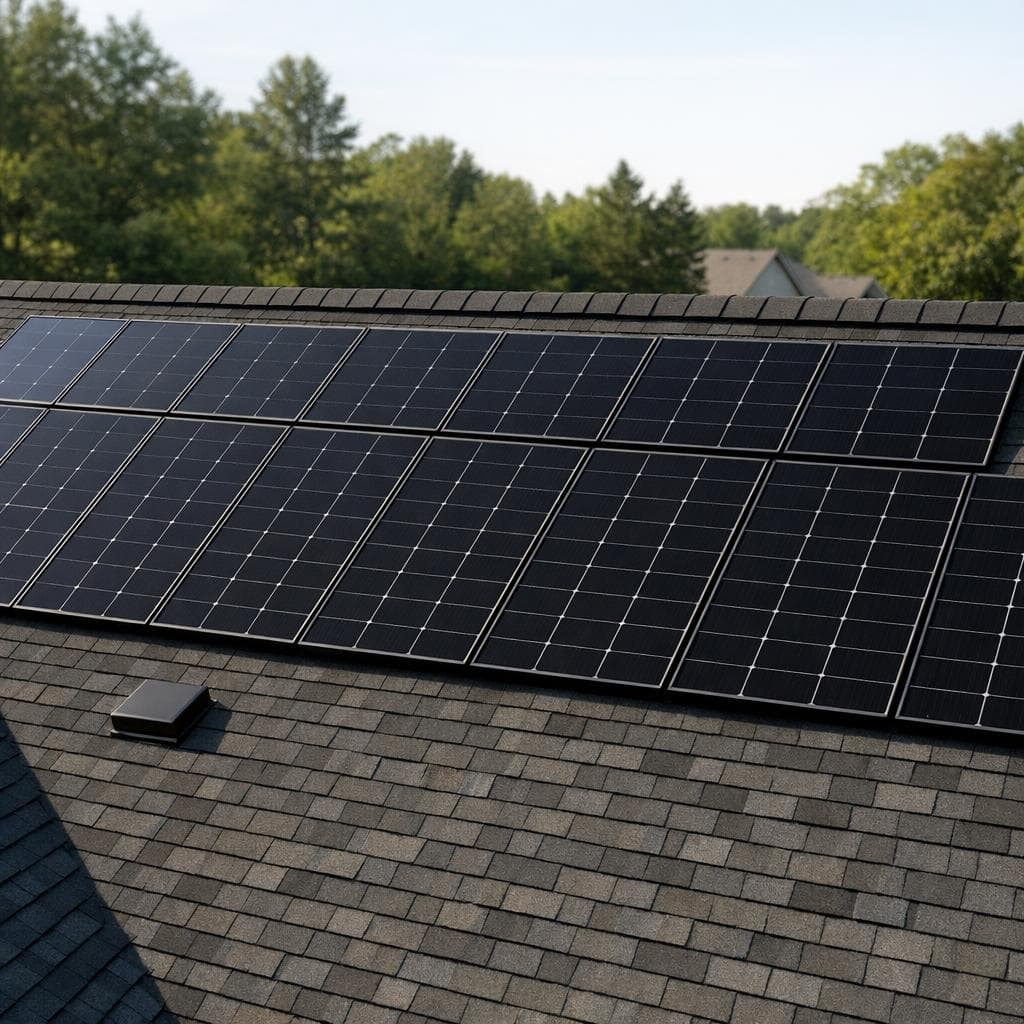
The 36-inch solar rule is a firefighter-access requirement that affects how close solar panels can be installed to the roof ridge. In most residential codes, your allowed ridge setback depends on how much of a given roof plane your array covers. When coverage is modest, a smaller setback is allowed. When coverage is high, you need a 36-inch clear strip at the ridge for safe operations. Because local authorities interpret and adopt code differently, you should treat the 36 inch solar rule as a design baseline, then confirm details with your Authority Having Jurisdiction. For typical steps and timelines that intersect with setback reviews, see the solar permitting and inspection timeline in the U.S..
How the 36-inch solar rule works on residential roofs
On sloped residential roofs, the rule links roof coverage to the minimum clear space at the ridge. If your array covers up to a defined portion of the roof plane, you can typically stop panels 18 inches below the ridge. If your array exceeds that threshold, you must leave a 36-inch setback at the ridge. Some jurisdictions describe this threshold as a percentage of the roof plane, others as the total roof area. You will also see the same concept referred to as the 33% rule or the 66% roof-plane rule. The intent is the same either way – maintain larger, safer access when arrays become expansive.
| PV coverage on a roof plane | Required ridge setback | Intent |
|---|---|---|
| Up to roughly 66% of the roof plane | 18 inches | Allows panels closer to the ridge while keeping access |
| More than roughly 66% of the roof plane | 36 inches | Creates a wider firefighter work zone at the ridge |
First calculate array coverage on a roof plane
The coverage check is a plan-view calculation. You compare the panel area on a single roof plane to that roof plane’s total plan area. Here is a practical way to do it before permitting and during your initial solar site assessment:
- Measure the roof plane’s length and eave-to-ridge run. Multiply for plan area.
- Calculate your array’s plan-view area on that same plane. Multiply the module width by height and count the modules on that plane.
- Divide array area by roof-plane area to get coverage as a percentage.
- Use the table above to determine whether the 18-inch or 36-inch ridge setback applies.
Example: A 30 ft by 12 ft roof plane is 360 sq ft. An array of 10 modules at 21.5 sq ft each equals 215 sq ft. Coverage is 215 ÷ 360 = 59.7%. That is below the high-coverage threshold, so an 18-inch ridge setback generally applies, pending local approval.
To optimize array placement while preserving required 36-inch pathways, see how to calculate solar access and TSRF.
Required pathways and setbacks beyond the ridge
The ridge strip is only part of firefighter access. Codes also require clear pathways for travel and ventilation. While exact dimensions and locations vary by jurisdiction, designers commonly account for:
- At least one clear pathway from the eave up toward the ridge along a roof side or between array blocks, often targeted at 36 inches.
- Clearances near hips, valleys, and gable edges so crews can navigate and ventilate without obstruction.
- Setbacks around skylights, chimneys, and mechanical equipment to prevent trip and entanglement hazards.
- Protection of emergency escape and rescue openings on exterior walls below, keeping panels and conduit from blocking access.
Treat these as planning guides rather than universal values. Your AHJ will specify exact pathway widths and locations during plan review. For a deeper look at what inspectors verify on site, read this solar site inspections 101 guide.
Exceptions and special cases the code official may allow
Fire access rules are designed for safety, but the code also lists cases where requirements can be reduced or adjusted. Common examples include:
- Detached garages and carports not intended for firefighter rooftop operations. Access rules may be relaxed or not required.
- Buildings or roof sections where the code official determines rooftop operations are not expected. Pathways and setbacks can be modified accordingly.
- Low-slope roofs with a pitch of 2:12 or less. These are often handled under different provisions than typical sloped roofs.
- Building-integrated PV (BIPV). If the official determines the system does not create additional fire or structural risks, certain setbacks can be adjusted.
Even when exceptions exist, document your design intent and request confirmation in writing from the AHJ before installation. Separately, confirm structural capacity early—start by verifying your roof is strong enough for solar.
Local rules vary – check your AHJ
The 36-inch solar rule is not a single national law. It originates from fire and residential codes that are adopted, amended, and interpreted locally. Always:
- Review your city or county solar permitting checklist for setback and pathway diagrams.
- Call or email the plans examiner to confirm how coverage is calculated in your jurisdiction.
- Show clearances on the plan set with measurements and labels so approval is straightforward.
This saves redesign time and ensures your 36 inch solar rule assumptions match local expectations. Upfront scoping—clarifying a solar site survey vs. site assessment—helps you capture setbacks and pathways correctly in the design.
Quick answers
What is the 36 inch solar rule?
It is a firefighter-access requirement that sets a minimum clear strip at the roof ridge, typically 36 inches when an array covers a high portion of a roof plane. With lower coverage, many jurisdictions allow an 18-inch ridge setback. The exact threshold and dimensions are confirmed by your local code official.
What is the 33% rule in solar panels?
Some jurisdictions frame the same concept as a percentage threshold. When array coverage exceeds a local threshold described as about one third of the roof or when a roof plane surpasses a defined share, a 36-inch ridge setback applies. Others describe it using the 66% roof-plane coverage split. Always verify your AHJ’s definition.
Does the 36-inch solar rule apply to low-slope roofs?
Low-slope roofs, often defined as 2:12 or less, are typically covered by different provisions. While clear access and pathways are still required, the specific ridge setback language for sloped roofs may not apply in the same way. Confirm the applicable section with your AHJ.
Are garages or carports exempt from roof access rules?
Detached garages and carports may not require the same rooftop access because firefighter operations are not expected there. This is determined by the code official. Submit your plans and request confirmation before finalizing the layout.
What is the solar 120% rule?
The 120 percent rule for solar is an electrical busbar rule from the National Electrical Code. It lets you backfeed a load center up to 120% of the busbar rating with certain conditions, such as breaker placement and conductor ratings. It is separate from roof setback and pathway rules.
Plan your layout faster with Enervio
Enervio helps solar teams turn roof-access rules into better designs, faster. Use remote property analysis to measure roof planes, estimate coverage on each plane, and visualize ridge setbacks and pathways in minutes. Generate code-aware layouts and 3D simulations that streamline plan review, reduce redesign loops, and keep projects moving. If your AHJ has unique interpretations, you can adjust parameters and instantly see compliant options.


