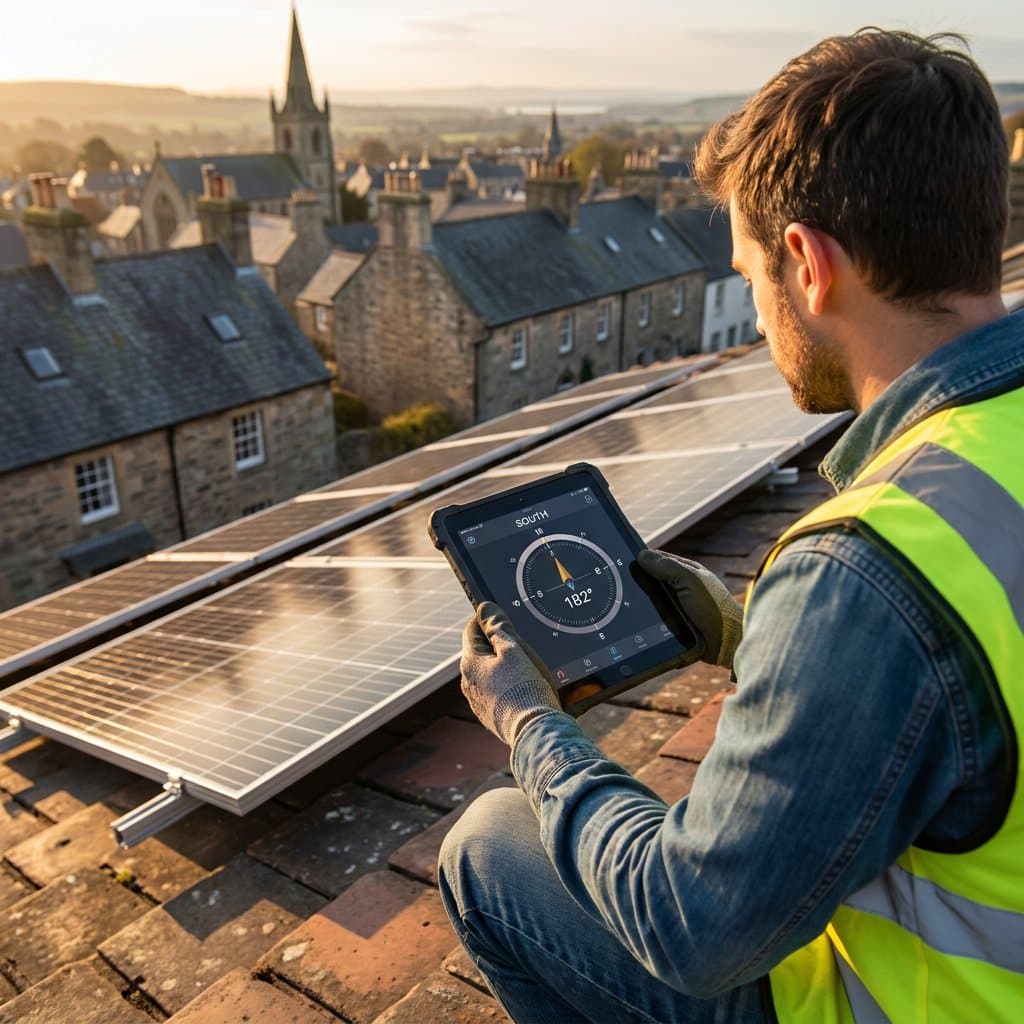
Solar Panel Azimuth
Solar panel azimuth is the direction your solar panels face on the horizontal plane, and it has a direct impact on energy production. If you want to estimate output, compare roof sections, or improve panel layout, azimuth is one of the first numbers to get right. In most cases, the best azimuth for solar panels points toward the equator, but real-world roofs, shading, weather patterns, and utility goals can change the ideal setup.
This guide explains the azimuth angle of solar panel systems in plain English, how it differs from tilt, what the optimal azimuth for solar panels usually is, and when a non-ideal roof direction still performs well. You will also learn how a solar panel azimuth calculator works and what inputs matter most when evaluating a site.
What is solar panel azimuth?
The solar panel azimuth angle describes the compass direction your photovoltaic array faces. In simple terms, it tells you whether your panels point south, southeast, east, southwest, or another horizontal direction.
For solar design, azimuth is usually expressed in degrees. A common convention for PV modeling is:
- 0° = facing the equator
- -90° = east
- 90° = west
- 180° = north
Some tools use standard compass notation instead, where south may be 180°, east 90°, and west 270°. That is why the azimuth definition for solar panels can look different from one calculator to another. Before you enter values into any solar panel azimuth calculator or PV azimuth calculator, check which angle convention the tool uses.
If you have ever asked, “What is the azimuth of a PV panel?” or “What is a solar azimuth?”, the short answer is this: it is the panel’s horizontal orientation relative to south or north, depending on the system used.
Solar panel azimuth vs tilt
Azimuth and tilt are closely related, but they are not the same thing.
- Azimuth is the left-right direction the panels face.
- Tilt is the up-down angle of the panels from horizontal.
When people search for solar panel azimuth and tilt or a solar panel azimuth and tilt calculator, they are usually trying to find the best combination of orientation and slope for annual production.
As a rule, azimuth affects when during the day your system produces the most energy, while tilt affects how directly the panels receive sunlight over the year. Both matter, but on many roofs orientation has the larger practical impact because you often cannot choose a completely different roof face without changing the installation layout.
What is the ideal azimuth for solar panels?
The ideal azimuth for solar panels usually points toward the equator:
- In the Northern Hemisphere, that generally means facing south.
- In the Southern Hemisphere, that generally means facing north.
This is the standard answer to “What is the ideal azimuth for solar panels?” and it is the most common starting point in solar simulation software.
For a fixed system designed for maximum annual output, the best azimuth angle for solar panels is normally the direction that gives the highest total yearly irradiation. In many residential projects in North America and Europe, that means due south or very close to it. In Australia, South Africa, and other Southern Hemisphere markets, the optimal azimuth for solar panels is generally due north.
That said, “ideal” does not always mean “perfectly centered.” A roof that is 10 to 20 degrees off the equator-facing direction can still perform very well. Small deviations often create only modest annual losses, which is why many viable projects are built on southeast- or southwest-facing roof planes.
How much does azimuth really affect solar output?
Azimuth matters, but the production penalty from being slightly off the ideal direction is often smaller than people expect. In general, output loss increases as the array points farther away from the equator-facing direction.
Practical pattern:
- Small deviations from the ideal azimuth usually cause small annual losses.
- East- and west-facing systems often still produce strong yearly totals.
- North-facing systems in the Northern Hemisphere usually show the largest performance drop.
On many projects, staying within about 15 degrees of the ideal azimuth leads to only minor yield loss. As the deviation becomes larger, the loss curve becomes more noticeable. That is why south-facing roofs are preferred in the Northern Hemisphere, but east- and west-facing roofs are still regularly used when roof shape, available area, or load profile supports them.
Azimuth also shifts the production window:
- East-facing panels generate relatively more in the morning.
- West-facing panels generate relatively more in the afternoon.
- Equator-facing panels usually maximize total annual output.
This can matter if your electricity usage or utility tariff places more value on morning or late-day production.
Best azimuth for solar panels by hemisphere
Northern Hemisphere
For most fixed systems, the best azimuth for solar panels is due south. Southeast and southwest orientations can still be very effective, especially when the roof geometry limits your options. East and west roofs are often acceptable, while north-facing roofs are usually less favorable for yearly production.
Southern Hemisphere
The logic reverses. The azimuth of solar panel arrays should usually point due north for best annual performance. Northeast and northwest can also work well, while south-facing roofs are often the least productive option for fixed arrays.
Near the equator
Closer to the equator, azimuth can be less dominant than in higher latitudes because the sun path is more balanced over the year. Local weather patterns, shading, and electricity pricing can have a larger influence on the best layout.
When south is not automatically best
The standard recommendation is useful, but it is not universal. A realistic solar design should also account for these factors:
Roof constraints
Many installations must follow the existing roof plane. If your largest usable roof section faces east or west, it may still outperform a smaller south-facing section simply because it fits more modules or avoids obstructions.
Shading and obstructions
Trees, chimneys, neighboring buildings, parapets, and roof equipment can change the best azimuth angle for solar panels. If a roof face gets heavy morning shade, a west-oriented array may outperform an east-oriented one. If afternoon shade is worse, the reverse can be true. For a step-by-step evaluation, see shading analysis for solar site inspections.
Local weather patterns
In some climates, morning sun is more reliable than afternoon sun, or vice versa. That means the optimal azimuth for solar panels can shift slightly away from the default equator-facing rule. Coastal cloud build-up, monsoon patterns, and recurring afternoon storms can all influence the best orientation.
Time-of-use economics
If electricity is worth more later in the day, a west-facing array may offer better financial value even if annual kWh is slightly lower than a south-facing design. This is one reason azimuth decisions should be based on both energy and economics, not just ideal geometry.
Magnetic declination and true azimuth
One of the most overlooked topics in azimuth planning is the difference between magnetic direction and true direction. A compass points to magnetic north, not true north. Solar design, however, should be based on true azimuth.
This difference is called magnetic declination. Depending on your location, the gap between magnetic and true north can be small or significant. If you use a compass without correcting for declination, your panel orientation can be off by several degrees.
That matters because azimuth calculations for solar panels should reference true geographic direction. So if you are checking a roof in the field or validating aerial measurements, use a declination-adjusted value rather than raw compass south or north.
Why true south and true north matter
- Solar simulation tools use geographic orientation, not magnetic orientation.
- Roof layout decisions become less accurate if compass readings are uncorrected.
- Small directional errors can stack with other design assumptions.
How to handle magnetic declination
If you are measuring a roof manually, look up the local magnetic declination for the property location. Then adjust your compass reading to get the true azimuth. The exact correction depends on whether the declination is east or west and which hemisphere you are in.
If you are using satellite imagery, GIS layers, or professional modeling software, the azimuth value is often already aligned to true geographic direction, which reduces the risk of field-measurement error.
How to calculate the azimuth angle for solar panels
If you want to calculate the azimuth angle of a solar panel system, the process usually starts with identifying the roof face orientation relative to true south or true north. The exact method depends on whether you are using a basic compass, aerial imagery, a solar design platform, or a dedicated azimuth angle calculator for solar panels. For on-site measurements, see how to perform a solar site survey.
Simple calculation workflow
- Identify the roof face you plan to use.
- Determine its direction relative to true north or true south.
- Convert that direction into the angle convention used by your software.
- Pair azimuth with tilt, shading analysis, and usable roof area.
- Run a yield estimate instead of judging azimuth in isolation.
Example using a common PV convention
- Due south = 0°
- Southwest = 45°
- West = 90°
- Southeast = -45°
- East = -90°
Under this convention, a roof plane facing slightly west of south might have a solar panel azimuth angle of 20° or 30°. A roof facing southeast might be -30° or -45°.
How a solar panel azimuth calculator helps
A solar panel azimuth calculator or PV azimuth calculator can save time by converting map direction, compass heading, or roof geometry into the exact azimuth input needed for modeling. The most useful tools also combine azimuth with tilt, shading, sun path, and production simulation so you can evaluate the full design rather than one number alone.
For solar businesses, this is where remote assessment tools are especially useful. Platforms like Enervio support property-specific solar analysis with roof data, solar simulation, and 3D visualization, helping teams estimate best roof pitch and orientation for solar, azimuth, usable area, and shading faster during the sales process.
Azimuth angle reference table for common roof directions
| Roof direction | Common PV azimuth value | Typical expectation |
|---|---|---|
| South | 0° | Usually best annual output in the Northern Hemisphere |
| Southeast | -45° | Strong production, more morning-weighted output |
| East | -90° | Lower annual output than south, stronger morning generation |
| Southwest | 45° | Strong production, more afternoon-weighted output |
| West | 90° | Often acceptable, stronger late-day generation |
| North | 180° | Usually weakest option in the Northern Hemisphere |
These values assume the common solar modeling convention where south is zero. Always confirm the convention used in your software before entering data.
Does azimuth matter if panels are flat?
If panels are installed completely flat, azimuth becomes much less important because the modules are not meaningfully oriented toward one horizontal direction. In that situation, tilt and drainage, soiling, structural loading, and spacing often become more important design concerns.
However, truly flat installations are uncommon for performance-focused systems. Even low-slope commercial arrays often include some tilt, row spacing, or orientation logic, so azimuth can still matter in practice.
Solar panel azimuth and trackers
Tracking systems reduce the importance of a fixed azimuth because the array moves to follow the sun. With single-axis tracking, the system usually rotates through the day from east toward west. With dual-axis tracking, both azimuth and tilt can change dynamically.
That said, trackers are not automatically the best solution. For many residential systems, the extra complexity and cost do not justify the gain. In commercial or utility-scale projects, the economics can be different. If you are evaluating fixed tilt versus tracking, compare total installed cost, maintenance, land use, and expected energy gain rather than focusing on azimuth alone.
How solar professionals use azimuth in real design work
Azimuth is rarely analyzed by itself. In real project workflows, it is one of several inputs used to estimate technical fit and commercial viability. A proper assessment usually combines:
- roof pitch and orientation
- usable roof area
- shading and obstructions
- module layout constraints
- local irradiation and weather conditions
- energy rates and utility rules
This is why modern solar teams increasingly rely on remote site analysis instead of rough manual estimates. Enervio, for example, treats azimuth as part of a broader remote property and solar simulation workflow, helping solar sales teams move from roof assessment to proposal much faster without depending on an on-site visit for every lead. You can also compare layouts and shade scenarios by using 3D solar simulations in proposals.
FAQ about solar panel azimuth
What is the ideal azimuth for solar panels?
For fixed systems, the ideal azimuth usually points toward the equator. That means due south in the Northern Hemisphere and due north in the Southern Hemisphere. The exact best value can still change based on sun and shadow analysis for site surveys, roof shape, weather, and rate structure.
What is the azimuth of a PV panel?
The azimuth of a PV panel is the horizontal direction it faces. It is usually expressed in degrees, such as 0°, -45°, 90°, or 180°, depending on the angle convention used in the design tool.
What is a solar azimuth?
Solar azimuth refers to directional orientation on the horizontal plane. In panel design, it usually means the facing direction of the array. In solar geometry, it can also describe the sun’s position in the sky. Context matters.
What is the best azimuth angle for solar panels?
The best azimuth angle for solar panels is typically the equator-facing direction for your hemisphere. But the best real-world answer depends on production goals, available roof faces, and site-specific losses.
Can east- or west-facing solar panels still be worth it?
Yes. East- and west-facing systems often remain financially and technically viable. They usually produce less annual energy than an ideal equator-facing system, but the difference may be acceptable, especially if roof area is good and shading is limited.
How do I calculate azimuth for solar panels?
You can calculate azimuth using corrected compass readings, aerial imagery, digital roof tools, or a solar panel azimuth angle calculator. Always confirm whether the tool uses true north, magnetic north, or a PV-specific south-based angle convention.
What is azimuth definition in solar panels?
In solar panels, azimuth means the compass orientation of the array on the horizontal plane. It is a core design input for energy modeling and system layout.
What is the 120 rule for solar panels?
The 120 rule is not an azimuth rule. It is an electrical interconnection guideline often used in panelboard calculations in the United States. It helps determine how much backfed solar breaker capacity can be added to a busbar. It does not tell you the ideal panel direction.
Does solar panel azimuth matter more than tilt?
It depends on the project, but on many roofs azimuth has a stronger practical effect because the available roof faces are fixed. Tilt still matters, especially for annual optimization, but orientation often drives the first layout decision.
Can software estimate azimuth remotely?
Yes. Modern solar software can estimate azimuth remotely using aerial data, roof geometry, 3D modeling, and simulation tools, including tools to calculate solar access and TSRF and even assess whether your house is too shady for solar.


