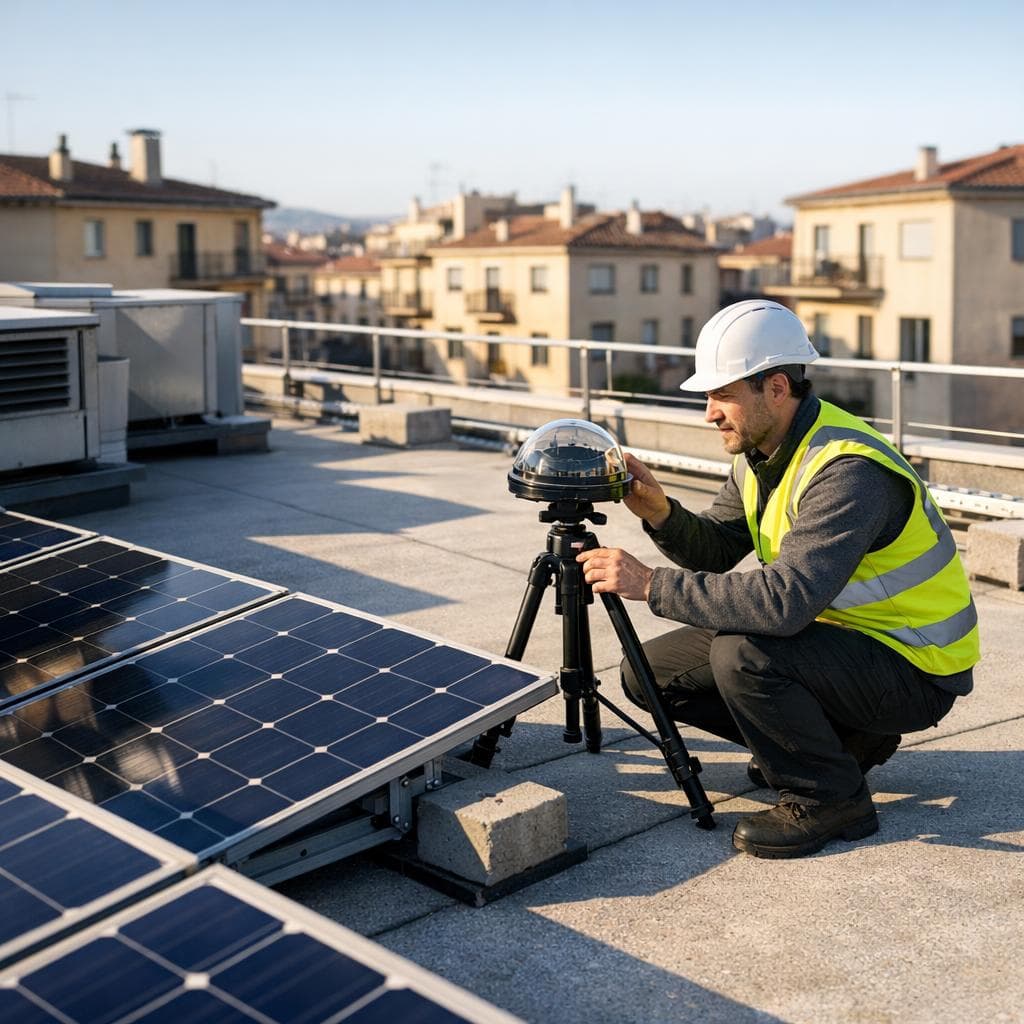
Sun and shadow analysis helps you understand how sunlight moves across a site and where shading reduces solar performance. If you design, sell, or assess solar systems, this analysis gives you a clearer view of usable roof space, likely energy yield, and the best location for panels. A strong sun and shadow analysis is not just about seeing where shadows fall at one moment. It is about tracking sun exposure across different times of day, seasons, and surrounding conditions so you can make better solar decisions with more confidence.
What sun and shadow analysis means in practice
At its core, sun and shadow analysis shows how the position of the sun affects a specific property or surface over time. It combines sun path data with the impact of nearby objects such as chimneys, dormers, trees, neighboring buildings, and terrain. The result is a practical way to measure how much direct sunlight reaches a roof, facade, or ground area.
For solar companies, this matters because shading directly affects system performance. Even partial shading on one section of a roof can lower overall output, influence string design, and change the economics of a project. A proper sun path and shadow analysis helps you identify which areas receive the most consistent sunlight and which areas are less suitable for panel placement.
Why sun and shadow analysis matters for solar projects
The main reason to run a sun and shadow analysis is simple: solar production depends on available sunlight. If a roof looks usable from above but receives heavy shade in the morning, late afternoon, or winter months, the expected return may be lower than it first appears.
This kind of analysis helps you:
- estimate solar potential more accurately
- spot shading risks before installation
- select the most productive panel layout
- improve proposal quality and speed
- reduce surprises during engineering or installation
For sales teams and solar developers, it also supports faster qualification. Instead of relying only on rough roof measurements, you can evaluate whether a site is truly viable and present a more realistic proposal from the start. This is especially effective when paired with remote solar site assessments.
For broader context and best practices, see the solar site inspections guide.
What a sun path and shadow analysis typically looks at
A useful analysis combines solar geometry with site-specific obstructions. That means you are not only looking at where the sun is, but also how the built environment changes actual sun exposure.
Sun position over time
The sun does not follow the same path every day of the year. Its height and angle change by season, which affects how long a roof stays exposed to direct sunlight. A complete analysis considers:
- time of day
- day of year
- sun altitude
- sun azimuth
- sunrise and sunset windows
Shadow sources on and around the property
Shadows can come from many places, both on the building itself and from the surrounding environment. Common sources include:
- trees and vegetation
- neighboring homes or commercial buildings
- chimneys, skylights, and roof equipment
- parapets and roof edges
- terrain or elevation changes
Solar exposure by roof section
Not every part of a roof performs the same. One slope may have strong midday exposure, while another may be shaded during key production hours. Breaking the roof into sections gives you a more reliable picture of panel suitability and expected output.
How to do shadow analysis for solar
If you want to do shadow analysis for solar properly, the goal is to move from a visual impression to a measurable assessment. A good workflow usually follows a few clear steps.
- Identify the property and build a usable roof model.
- Map roof geometry, slope, orientation, and obstacles.
- Model nearby shade sources such as trees and adjacent buildings.
- Simulate sun movement across different dates and times.
- Measure where shadows fall and for how long.
- Compare solar exposure across all usable roof areas.
- Use the result to guide system design, panel placement, and yield expectations.
To quantify exposure and shading consistently, see calculate solar access and TSRF.
For basic projects, you may only need a high-level shading check. For more complex properties, a 3D solar simulations for shading approach is often the better option because it reflects the actual geometry of the site more closely.
What a good analysis should help you answer
A useful sun and shadow analysis should not stop at visualization. It should help you answer practical questions that affect project quality and profitability.
- Which roof planes receive the most direct sunlight?
- How much shading occurs in the morning, midday, and afternoon?
- Are there seasonal shading issues in winter or summer?
- Which obstacles reduce usable panel area?
- Can the system size still meet the customer’s expectations?
- Does shading require changes to layout or electrical design?
Key outputs from sun and shadow analysis
The most valuable outputs are the ones that directly support design and quoting decisions. Depending on the platform, these outputs may be shown in maps, 3D views, or roof-level summaries.
| Output | What it tells you |
|---|---|
| Sun path view | How the sun moves across the site during the day and year |
| Shadow map | Where shadows fall at selected times and dates |
| Solar exposure estimate | How much usable sunlight a roof section receives |
| Roof obstruction map | Which physical features limit panel placement |
| 3D site visualization | How surrounding buildings and objects affect shading |
Common use cases for sun and shadow analysis
Although the concept is used in architecture, landscaping, and photography, the most direct value on a solar-focused page is in project assessment and design.
Residential solar qualification
You can quickly determine whether a home has enough sunlight to support a viable installation. This is especially useful when you want to reduce unnecessary site visits and pre-qualify leads faster.
Commercial roof assessment
Larger buildings often have more complex roof layouts, equipment, and partial shading. A structured analysis helps you identify the best zones for panel placement and avoid overestimating available capacity.
Remote proposal generation
When you can assess shading remotely, you can create more accurate early-stage proposals without waiting for a full on-site survey. That shortens response time and helps move leads through the pipeline faster. A broader checklist such as site survey questions about shading can help make sure no important detail is missed.
2D checks versus 3D sun and shadow analysis
Simple map-based checks can be useful for a first review, but a 3D approach gives a clearer picture when roof geometry and nearby structures are more complex. This matters because shadows are not flat. Their length and direction change with height, shape, and season.
A 3D sun and shadow analysis is especially useful when you need to account for:
- multi-level roofs
- steep roof pitches
- trees with irregular canopy shapes
- dense urban surroundings
- equipment-heavy commercial rooftops
For solar teams, 3D visualization makes it easier to explain results internally and to customers, because it shows not only that shading exists, but where it comes from and how it affects layout decisions. This becomes even more valuable when customizing solar proposals with 3D visuals for customer-facing presentations.
Where many solar assessments go wrong
One of the most common mistakes is treating a roof as if all areas receive the same sun exposure. Another is checking shading only at a single moment instead of across multiple dates and times. Both can lead to unrealistic production estimates.
Other common issues include:
- ignoring tree growth or seasonal foliage
- missing small roof obstacles that reduce usable space
- underestimating winter shading when the sun is lower
- using rough visuals without a structured shadow study
The better your analysis, the more likely you are to deliver a system design that performs as expected after installation. In many cases, this also depends on getting the best roof pitch and orientation for solar into the evaluation from the start.
How Enervio supports faster solar shading assessment
Enervio helps solar businesses perform remote sun and shadow analysis as part of a broader AI-driven workflow for faster solar sales and assessment. Instead of relying only on manual review, you can use remote property data, 3D visualization, and simulation to understand roof suitability and shading impact earlier in the process.
That makes it easier to assess solar potential, identify layout constraints, and generate tailored proposals without a site visit in every early-stage case. For growing solar companies, this means a faster path from lead to quote while keeping the analysis grounded in real property conditions. For a deeper look at related methods, see shading analysis for solar site inspections.
FAQ about sun and shadow analysis
What is the relationship between sun and shadow?
Shadows are created when an object blocks sunlight. As the sun changes position throughout the day and year, the length and direction of the shadow also change. In solar planning, this relationship matters because changing shadows affect how much direct sunlight reaches a roof or panel area.
How to do shadow analysis for solar?
You start by identifying the roof shape, orientation, and nearby obstacles. Then you model how the sun moves across the property at different times and dates. From there, you measure where shading occurs, how long it lasts, and how it affects usable panel area and expected energy production.
What is a sun path and shadow analysis?
A sun path and shadow analysis combines the movement of the sun with the effect of buildings, trees, roof features, and terrain. It shows how sunlight reaches a site over time and where shadows reduce solar exposure.
Why is seasonal analysis important?
The sun sits higher in summer and lower in winter, so shading patterns change across the year. A roof that looks clear in one season may experience more shading in another. Seasonal analysis gives you a more realistic view of annual solar performance.
Can you do a sun and shadow analysis remotely?
Yes, many solar assessments can begin remotely using property data, roof measurements, 3D modeling, and shading simulation. Remote analysis is especially useful for lead qualification and early-stage proposal work.
What objects usually cause the biggest shading issues?
Trees, neighboring buildings, chimneys, dormers, HVAC equipment, and parapets are among the most common sources. The impact depends on their height, distance, and orientation relative to the roof and the sun path.
Is a simple shadow map enough for solar design?
For basic screening, it can be enough. For accurate solar design, a more detailed analysis is often needed, especially on roofs with multiple planes, nearby obstructions, or complex geometry.


