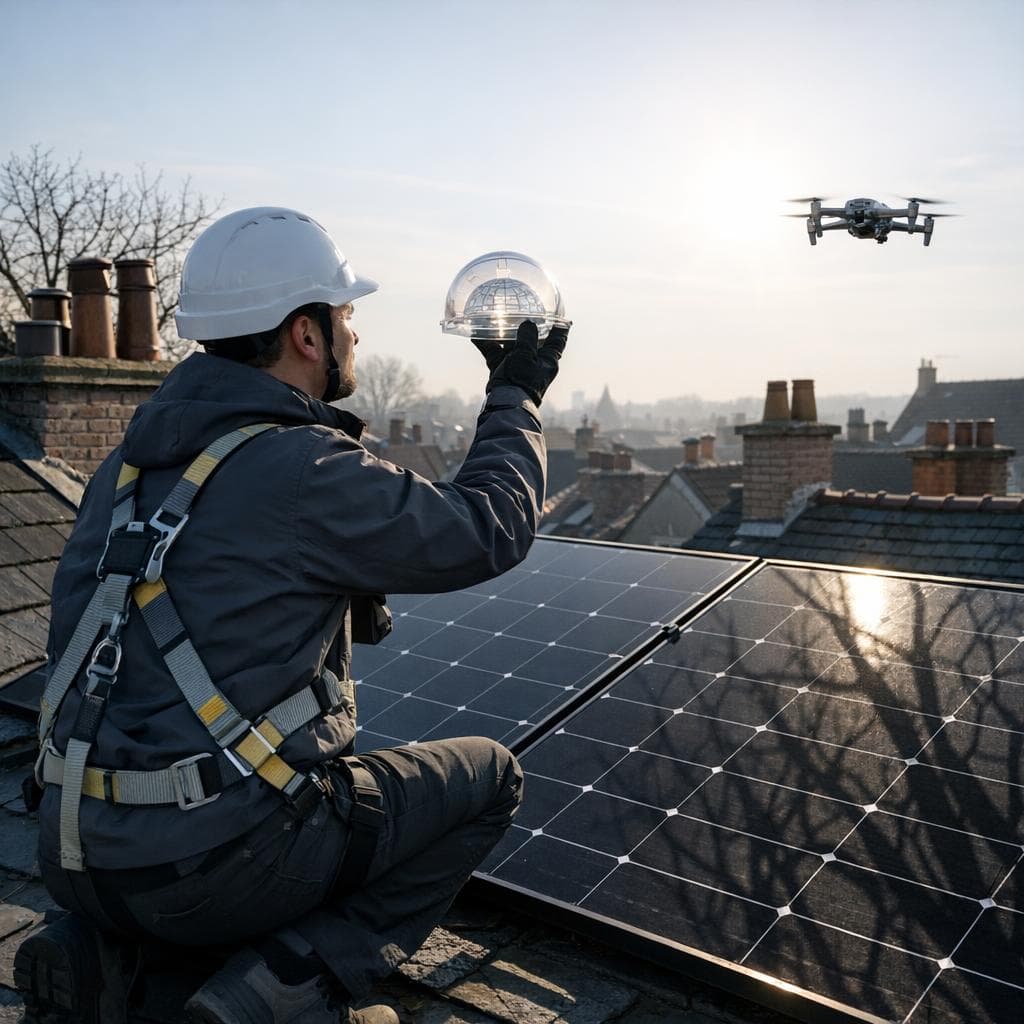
Solar shading analysis shows when, where, and how objects cast shadows that reduce solar access on roofs, facades, ground arrays, and surrounding spaces. Accurate shade modeling drives better solar panel performance, comfort in buildings, compliance in urban planning, and reliable financial outcomes. This guide explains core concepts, metrics, methods, and tools – from handheld devices and desktop software to 3D web platforms and AI – so you can choose the right solar shade analysis tool and workflow for your project.
What is solar shading analysis and why it matters
Solar shading analysis is the process of quantifying the impact of obstructions on available sunlight throughout the year. It combines solar geometry, site data, and 3D context to determine solar exposure, shadow extents, and energy losses. For solar PV, even partial shading can cause disproportionate yield reductions and hot spots, affecting payback and warranties. In architecture and BIPV, shade informs glazing, overhangs, and facade systems to balance daylight, heat gains, and glare. Urban development requires shadow studies to limit overshadowing of public spaces and neighboring properties. Well-executed analysis supports accurate production estimates, optimized array layout, compliant building design, and credible project finance.
Core concepts and solar geometry
Sun position is defined by solar altitude and azimuth and varies by date, time, and latitude. Shadows elongate in winter and shrink in summer, with daily changes driven by hour angle. Orientation, tilt, and obstruction geometry determine when direct sun is blocked. Diffuse sky radiation partly compensates for shade, but crystalline PV relies heavily on direct irradiance. Precise site coordinates, elevation, and a correct horizon profile are essential to avoid systematic bias.
Key metrics you will use
- Solar Access Value (SAV) – Percentage of potential sun that reaches a surface over a defined period. Common thresholds for residential PV target 85 to 90 percent or higher annually.
- Total Solar Resource Fraction (TSRF) – Combines shading losses with orientation and tilt effects relative to an optimal plane. Useful for comparing candidate roof sections. Learn how to calculate solar access and TSRF.
- Tilt Orientation Factor (TOF) – Quantifies how far a surface deviates from an ideal orientation and tilt given the local climate.
- Shading percentage or Shading coefficient – Portion of time or irradiance blocked by obstructions for a surface, time window, or sun path segment.
Use annual, seasonal, and critical-hour windows to reflect the project’s objectives, such as summer comfort or winter PV production.
Step-by-step solar shading analysis process
- Define objectives – PV energy yield, comfort, urban compliance, or valuation. Choose the assessment period and key metrics up front.
- Collect site data – Address or coordinates, roof geometry, tilt, azimuth, heights, nearby obstructions, tree species and maturity, imagery sources, property boundaries, and design constraints. Use Solar site survey questions to standardize shading and obstruction inputs.
- Build the 3D context – Model roofs, facades, terrain, and obstructions. Use accurate elevation data and validated footprints. For ground mounts and a solar plant, include racking height, row spacing, and terrain undulations.
- Run simulations – Calculate hourly or sub-hourly sun paths, cast shadows, and aggregate into SAV, TSRF, or energy yield with your chosen weather dataset.
- Optimize layout – Adjust module placement, orientation, and stringing to limit mismatch. Test alternate tilt, row spacing, or selective trimming for vegetation. For roof design trade-offs, review Roof pitch and orientation for solar.
- Validate and report – Cross-check with field observations or drone imagery when needed. Export clear visuals, time-slice charts, and assumptions to support decisions and permitting.
Methods and tools for shading analysis
Manual devices and field techniques
Handheld instruments remain popular for quick site assessments and shaded roof scans without building a detailed 3D model. Two commonly used tools are:
- Solar Pathfinder – A passive dome with sun-path overlays that captures the local horizon. It helps estimate solar access and seasonal shading. Advantages are simplicity and no power requirement. Limitations include operator dependence and lower repeatability under poor lighting.
- Solmetric SunEye (110 and 210) – A digital fisheye camera with onboard sun-path analysis. SunEye shade analysis can produce SAV and monthly estimates quickly on-site. The Solmetric SunEye 210 is widely referenced; see the vendor for the Solmetric SunEye 210 manual and any Solmetric SunEye download resources. Strengths include speed and consistent digital capture. Limitations include cost, reliance on proper leveling and north alignment, and potential distortion around extreme fisheye edges.
Manual methods are excellent for quick yes-no screening or validation. For design optimization, stringing decisions, or large sites, combine them with software-based 3D solar shading analysis for higher accuracy and scenario testing.
Software for 3D and PV shading analysis
Desktop and cloud tools deliver precise 3D solar shading analysis, energy modeling, and reporting. For time-based visual storytelling, see Using 3D solar simulations.
- PVSyst – Industry-standard for PV system design and bankable yield. PVSyst shadow analysis models near and far shading, module strings, and electrical effects. Ideal for residential to utility scale.
- HelioScope and PV*SOL – Streamlined PV layout and loss modeling, strong for rooftop portfolios and rapid iterations.
- SketchUp with solar plugins or Rhino with Ladybug Tools – Flexible 3D modeling for facades and urban massing, with detailed sun studies and parametric workflows.
- GIS and city platforms – Leverage LiDAR and building footprints for large-area shadow analysis for solar plant siting or citywide PV potential.
Choose software based on your objective: bankable PV yield, architectural studies, or city-scale screening. For precision PV shading analysis and solar panel shadow analysis, use tools that handle module mismatch, bypass diodes, and row-to-row shading. For architectural and BIPV studies, prioritize daylight, glare, and seasonal comfort in addition to solar access.
Web and mobile tools
Web apps and phone-based shade analysis tools offer fast assessments using aerial imagery and simplified 3D context. These methods enable Remote solar site assessments. They are handy as a Solmetric SunEye alternative for early-stage solar site assessment, but confirm critical projects with higher-fidelity desktop modeling or field validation.
Drone, LiDAR, and aerial imagery
Drone photogrammetry and aerial LiDAR improve accuracy where terrain is complex or vegetation dominates. With a precise point cloud or mesh, you capture true heights of trees, parapets, and neighboring structures. For shadow analysis for solar plant siting, these datasets reduce guesswork on horizon profiles and row spacing. Consider regulatory constraints, flight planning, and processing time. Where open data provides reliable LiDAR, you can skip expensive captures and still achieve robust outcomes.
AI-powered shade prediction
AI models can infer roof shapes, obstructions, and likely shade patterns from aerial imagery and street-level photos. Combined with weather files and panel layout rules, AI accelerates remote proposals and cuts site visit costs. Use AI to pre-qualify leads, rank roof sections, and produce consistent first-pass solar panel shading analysis, then deepen with detailed 3D modeling where needed. AI does not replace physics-based simulation, but it reduces cycle time and improves quoting accuracy.
Applications by sector
Photovoltaic systems
For rooftop and ground-mount PV, minimize shade on the most productive hours and months, balance tilt with row-to-row spacing, and isolate frequently shaded modules on separate strings or optimizers. Inverters with multiple MPPT inputs reduce mismatch. For utility scale, model horizon shading, tracker backtracking, and terrain-driven self-shading to optimize LCOE.
Architecture and BIPV
Use shade analysis to size overhangs, angle fins, and select glazing that manages solar gains without sacrificing daylight. For BIPV, reconcile energy production with facade aesthetics, code constraints, and thermal comfort.
Urban planning
Shadow studies demonstrate compliance with local rules on overshadowing of streets, parks, and neighboring lots. Simulate seasonal worst cases, document critical hours, and communicate impacts with clear visuals for stakeholders.
Real estate and valuation
Solar access influences property value, energy bills, and potential PV revenue. Include a concise solar shadow analysis in due diligence to flag constraints and opportunities.
Agrivoltaics and landscaping
Balance crop light needs with panel output by tuning height, spacing, and tilt. For gardens and campuses, schedule plantings by expected sun hours and account for tree growth.
Photography and cinematography
Plan shoot timing and framing by predicting sun angles, shadow lengths, and facade exposure at target hours.
Common pitfalls and how to avoid them
- Ignoring seasonal variation – Analyze at least solstices and equinoxes and weight results to project goals.
- Under-modeling vegetation – Include species height and growth. Consider leaf-on and leaf-off scenarios for temperate climates.
- Relying on single images – Cross-check with multiple imagery sources and recent site photos to avoid outdated context.
- Overlooking electrical effects – For PV shading analysis, account for stringing, bypass diodes, and module orientation to avoid mismatch losses.
- Using DIY tools as final truth – Phone apps are fine for screening. Validate critical decisions with calibrated devices or bankable software.
- Forgetting oblique sun – Early morning and late afternoon shadows can drive complaints and performance dips. Include critical-hour windows in reports.
How Enervio supports solar shading analysis
Enervio is an AI-driven SaaS platform for solar companies that need faster, more accurate remote assessments and proposals. You can:
- Collect property characteristics remotely and generate consistent, personalized AI estimates for leads.
- Create 3D visualizations of properties with sun, shadow, and solar panel simulations to speed up design conversations; see 3D visuals in solar proposals.
- Screen portfolios quickly with AI to prioritize high-SAV roof areas and flag obstructions before site visits.
- Integrate Enervio into existing workflows and CRMs to reduce sales cycle time and operational costs.
Use Enervio for rapid early-stage solar shading analysis, then hand off to detailed tools like PVSyst for final engineering where required. This blended approach increases throughput without compromising accuracy when it matters.
FAQ
What is a good Solar Access Value for residential PV?
Many installers target an annual SAV of 85 to 90 percent or higher for rooftop PV. Local tariffs, incentives, and array specs can shift the threshold slightly.
How accurate are handheld devices vs software?
Tools like Solar Pathfinder and Solmetric SunEye are reliable for screening and quick reports. For bankable estimates, pair field data with detailed 3D modeling and energy simulation.
Is PVSyst shadow analysis still the benchmark?
Yes. PVSyst shadow analysis remains a bankable standard for near-field shading, electrical mismatch, and production modeling across residential to utility scale.
What is a Solmetric SunEye alternative?
Web platforms and mobile apps provide rapid roof scans using aerial data. They are useful for early solar site assessment, but verify critical projects with higher-fidelity methods.
What data do I need to start a shade analysis?
Location, roof geometry, tilt and azimuth, obstruction heights, recent imagery or LiDAR, and weather files. For a solar plant, add terrain, row spacing, and tracker specs.


