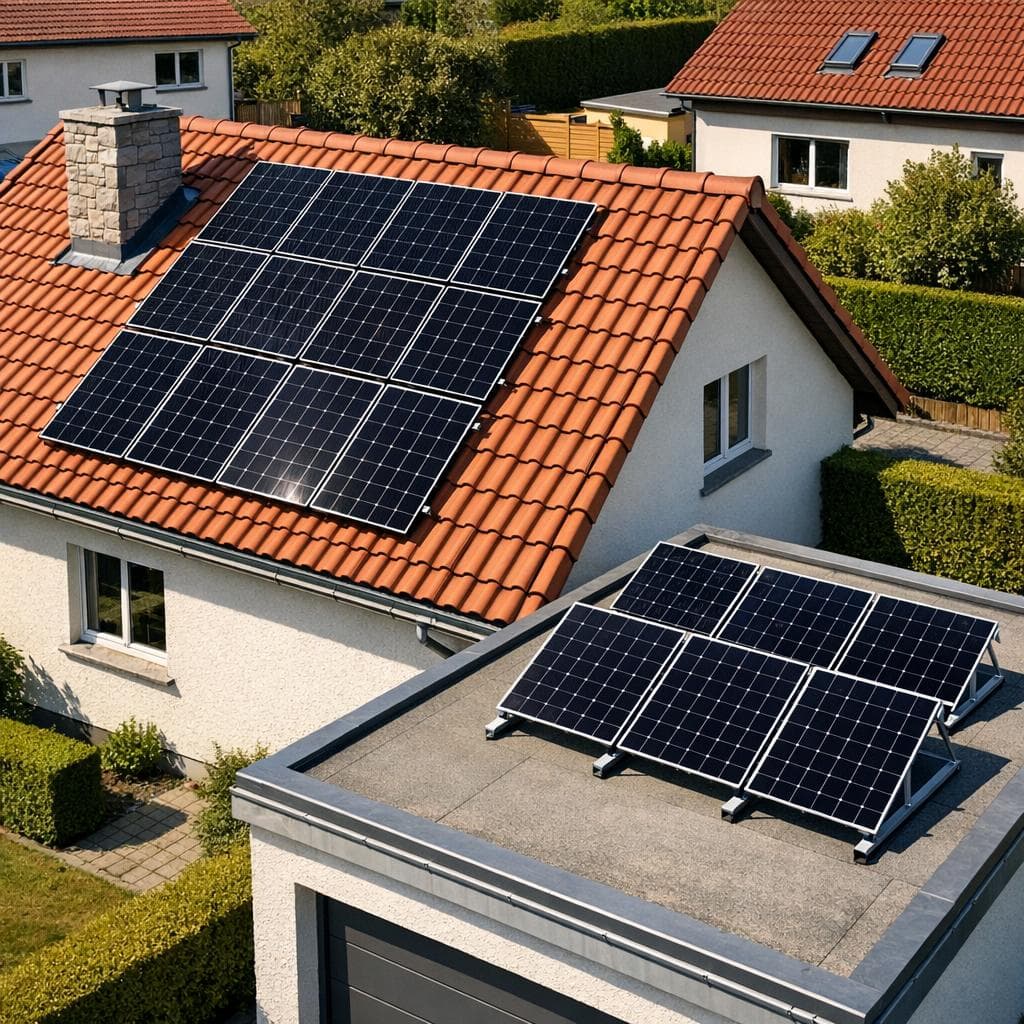
The ideal roof pitch for solar panels typically sits around your latitude, often landing between 25 and 40 degrees for most homes. Orientation usually matters more than pitch – a south-facing array at a slightly off angle will often outperform a perfectly angled system facing east or west. Even if your roof is flat or steep, you can still achieve excellent performance with the right racking, layout and electronics. This guide shows you how to pick the best angle for your roof, what to do when it is not ideal, and how it affects efficiency, cost and ROI.
Why roof pitch matters for solar efficiency
Solar panels perform best when sunlight hits them as close to perpendicular as possible. Pitch changes the incidence angle of sunlight over the seasons, which influences daily and annual energy yield. Too shallow and winter sun arrives at a glancing angle, reducing winter output. Too steep and summer noon production can dip. The sweet spot balances year-round production for your location, roof orientation and shading profile. In practice, many common pitches deliver within a few percentage points of each other, so getting orientation and shade control right typically drives bigger gains than obsessing over a perfect degree number. To quantify the impact of tilt, azimuth and shade for your roof, review How to calculate solar access and TSRF.
What roof pitch is and how to measure it
Roof pitch describes the steepness of your roof. In building terms it is often expressed as rise over run, like 6:12 – meaning the roof rises 6 inches for every 12 inches of horizontal run. You can convert this to degrees to compare with solar angle rules. Pitch measurement is typically part of a full What is a solar site assessment?.
To measure safely from the ground, use a smartphone inclinometer pointed along an exposed rafter edge or a level placed against a soffit or gable trim, then convert to roof angle. If an early site visit isn’t possible, you can estimate roof tilt from imagery and LiDAR through Remote solar site assessments for sales. If you must measure on the roof, use a level marked at 12 inches and a tape measure to read the rise at the far end – then convert 4:12, 6:12, etc. Always prioritize safety or have a professional confirm the pitch during a site visit. For on-site verification and safety best practices, see the Solar site inspections 101 guide.
Angle vs orientation – what matters more?
Orientation usually moves the needle more than pitch. In the Northern Hemisphere, true south maximizes annual output, with southeast to southwest typically within 5 to 10 percent. East or west facing roofs can still be viable, often seeing 10 to 20 percent lower annual yield than south – but may align better with afternoon consumption or time-of-use rates. Within common roof pitches from about 15 to 40 degrees, annual differences are often modest compared to orientation or shading. If your orientation is fixed, small tilt adjustments can help, but eliminating shade and using module-level power electronics often deliver larger gains.
The ideal roof angle by latitude
A reliable rule of thumb is to set your solar panel tilt close to your latitude. Near 25 to 35 degrees latitude, an angle in the high 20s to mid 30s usually delivers strong year-round performance. Farther from the equator, steeper angles improve winter harvest by pointing panels more squarely at the low winter sun. Closer to the equator, shallower tilts perform well because the sun climbs higher overhead.
Seasonal adjustments simplified
If you can adjust tilt seasonally, a simple approach is latitude plus about 15 degrees for winter and latitude minus about 15 degrees for summer. Most roof-mounted systems are fixed for aesthetics and cost reasons, so installers target a fixed angle near latitude or near the roof pitch if the tradeoffs are small. On flat roofs, low-tilt racking between 5 and 15 degrees is common to balance energy yield with row spacing, wind load and ballasting needs.
Common roof types and what works
Flat roofs (0 to about 2 degrees)
Flat roofs work very well with tilt racking. Low tilts of 5 to 15 degrees reduce wind load and allow tight spacing, while still shedding water and dirt. Ballasted systems avoid roof penetrations where feasible, though structural checks are essential. The tradeoff is added racking cost and potential row-to-row shade if tilt is too high or spacing too tight. Orientation flexibility is a big advantage – you can point arrays south or split east-west to extend production across the day.
Low-slope roofs (about 3 to 18 degrees)
Low-slope roofs often perform well with flush mounting when the pitch already falls near your latitude. If the roof is much shallower than latitude, small tilt frames can close the gap. Keep row spacing, parapet shading and nearby obstructions in mind. In many cases the incremental gain from tilting a few extra degrees is modest, so prioritize shade control, orientation and minimal wind loading.
Standard pitch roofs (about 19 to 40 degrees)
This is the sweet spot for many homes. Flush-mounted arrays usually align close enough to the optimal angle to deliver near-peak annual output, especially on south-facing planes. East or west planes at these pitches also work, typically with a modest annual yield reduction but potentially better alignment with morning or afternoon loads. Snow shedding improves above roughly 30 degrees in colder climates.
Steep roofs (40 degrees and above)
Steep roofs can still be excellent for solar, especially where winters are long and snowy. Energy shifts toward winter months, and snow slides off more readily, keeping modules clear. Drawbacks include higher installation labor, more stringent safety anchoring and sometimes visible racking. On very steep roofs, installers may choose lower profile mounting systems to reduce wind load and improve aesthetics.
Common roof pitches and degree conversions
Use this quick reference to convert building pitch to degrees for solar angle planning.
| Pitch (rise:run) | Degrees |
|---|---|
| 0:12 | 0° |
| 2:12 | 9.5° |
| 3:12 | 14.0° |
| 4:12 | 18.4° |
| 5:12 | 22.6° |
| 6:12 | 26.6° |
| 7:12 | 30.3° |
| 8:12 | 33.7° |
| 9:12 | 36.9° |
| 10:12 | 39.8° |
| 12:12 | 45.0° |
How to overcome a non-ideal roof pitch
If your roof is too flat or too steep, you still have options. Tilt racks can dial in the optimal angle on flat or low-slope roofs. On sloped roofs, microinverters or optimizers mitigate mismatch from shading or split orientations. Ground mounts or carports let you choose a near-perfect tilt and azimuth when roof space is limited. East-west racking on flat roofs reduces row spacing needs and broadens the production curve, which can improve self-consumption under time-of-use rates. Your best approach balances energy yield, wind and snow loads, aesthetics and total installed cost.
Shading, weather and snow load considerations
Even the best roof pitch underperforms if shading isn’t controlled. Map tree, chimney and vent shadows for winter and summer sun paths, then optimize module placement accordingly. In snowy climates, steeper angles shed snow better, but low-tilt arrays can perform well with proper maintenance and clearances. In high-wind regions, lower tilt and aerodynamic racking reduce uplift forces and ballast needs. Local weather patterns matter too – where summers are cloudy and winters are clear, a slightly steeper tilt can lift winter output. Where afternoon utility rates peak, a west or southwest emphasis can boost bill savings even if annual kWh are slightly lower.
Mounting systems and cost impact by pitch
On standard pitched roofs, flush rail systems are usually the most cost-effective and visually discreet. Steeper roofs often add labor for access and safety, nudging installation costs higher. Flat roofs typically require racking and, where allowed, ballasted systems – this adds hardware cost but preserves waterproofing. Tilted flat-roof systems may need wider row spacing to avoid self-shading, which can increase total footprint. The right choice weighs added energy from a higher tilt against extra structural review, wind load accommodations and material cost. In many cases, a near-roof tilt that reduces complexity offers the best overall ROI.
Performance and ROI impact of angle
Tilting panels to latitude is a strong all-round target, but the ROI picture depends on orientation, shading and utility rates. A 5 to 10 degree miss from the theoretical optimum often changes annual output by only a few percent. Meanwhile, poor azimuth or recurring shade can cut production far more. If nudging tilt by 5 degrees requires expensive racking or structural upgrades, you might be better off investing in more modules, shade mitigation or higher efficiency electronics. Model scenarios with your installer to compare annual kWh, bill savings and payback at different tilts before committing.
Quick decision framework: pick your best roof pitch in minutes
Use these steps to identify your optimal tilt and when to adjust from your roof’s native pitch.
- Confirm basics: note roof pitch, azimuth and any nearby shading sources across seasons. Use a checklist like Solar site survey template questions.
- Start with latitude: use your latitude as the baseline tilt for fixed arrays.
- Check orientation: if you are true south, staying near native pitch is usually fine. If east or west, small tilt changes won’t fix azimuth – consider module-level electronics and layout tweaks first.
- Account for climate and rates: in snowy or high-latitude regions, consider slightly steeper tilts. Under time-of-use rates, west or southwest orientations may outperform pure south in bill savings.
- Evaluate cost vs gain: estimate the extra kWh from tilting vs added racking, ballast or labor. In many cases, a simpler mount with better shade control wins.
- Validate with software: use a reputable solar angle calculator or design tool to compare 2 to 3 scenarios and pick the best value, including 3D solar simulations.
Building a solar sales proposal or property review? Enervio helps solar teams run remote property analysis, AI-driven estimates and 3D visualizations so you can compare tilt and orientation scenarios quickly and present a clear, data-backed recommendation.
FAQ
What roof pitches work well with solar panels?
Most pitches from about 15 to 40 degrees work very well. Near your latitude is an excellent baseline. If you are outside that range, you can still achieve strong results with tilt racking on flat roofs or module-level electronics on sloped roofs. Orientation and shading typically have a bigger impact than small differences in pitch, so prioritize a south-facing plane where possible and mitigate shade before investing heavily to change tilt.
What is the 33% rule in solar panels?
Many designers use a 33% guideline to oversize the DC array relative to inverter AC rating – often called a DC-to-AC ratio around 1.33. This improves inverter loading during lower irradiance hours without significantly clipping on peak days. It is not a roof pitch rule, but it can increase annual energy yield for a given inverter size. Always follow local codes and manufacturer specs when selecting equipment and ratios.
Why is it difficult to sell a house with solar panels?
It usually isn’t difficult when the system is owned, permitted and documented, since many buyers value lower bills. Challenges arise when panels are leased or financed with liens that must be transferred, or when system records, warranties or permits are missing. Appraisals can vary by market. Roof condition and age also matter – buyers want confidence the roof will last under the array. None of this is about roof pitch, but pitch can influence perceived aesthetics and access for future maintenance.
What is the 120 rule for solar panels?
The 120% rule is an electrical code concept in the U.S. that limits how much solar current can backfeed a service panel busbar. In simple terms, the main breaker plus solar breaker cannot exceed 120% of the busbar rating unless other methods are used. It ensures safe loading of electrical equipment. While unrelated to roof pitch, it can affect system sizing and interconnection choices. Always consult a licensed electrician or your installer for code compliance.
Is adjustable tilt worth it on a roof-mounted system?
Usually not for homes, because the added racking cost, roof access and labor rarely pay back compared to a well-placed fixed array. Adjustable tilt makes more sense on ground mounts or certain flat-roof commercial systems where seasonal changes can be done safely and quickly. If you are already close to your latitude angle and have minimal shade, fixed tilt is typically the best value.
Next steps to lock in your best angle
Start with your latitude and roof’s native pitch, then layer in orientation, shading and local climate. Model two or three tilt options to compare annual kWh and bill savings – a small angle change might not justify extra racking, while shade mitigation or layout tweaks could deliver larger gains. If you sell or design solar, Enervio lets you conduct remote property analysis, generate AI-powered estimates and visualize tilt and azimuth options in 3D so you can present a clear, optimized plan to your customer.


