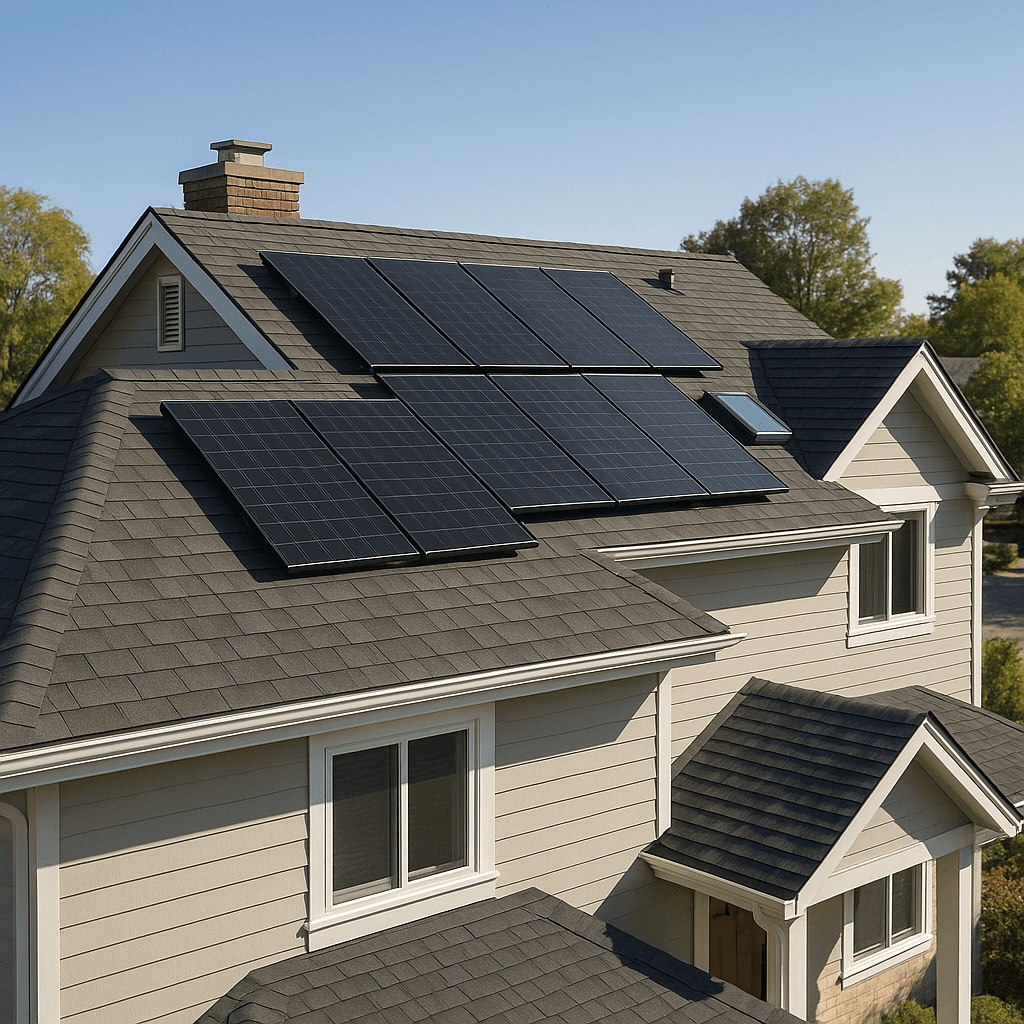
Putting solar on a roof starts with one question: can the structure safely carry the added loads over its full service life. This guide gives you a practical, engineer-ready overview of loads, codes and roof conditions that determine feasibility. Use it to pre-qualify properties, talk confidently to AHJs and engineers, and choose the right mounting approach without surprises.
The loads that drive rooftop solar design
Every rooftop PV design must check the combined effect of permanent and environmental loads on the roof framing and connections. You will size anchors, rails and spacing so that gravity loads are supported and uplift is resisted with adequate safety factors.
Key load types to consider:
- Dead load – The permanent weight of modules, racking, wiring and any ballast. Typical attached systems add only a few psf, while ballasted systems add more. Use manufacturer data and include retained snow or soiling if relevant.
- Live load – Temporary loads such as workers, tools and maintenance activity. Some jurisdictions require you to maintain a minimum live load after PV is installed.
- Wind load – Uplift and sliding forces increase at edges, corners and roof perimeters due to higher pressure coefficients. Taller buildings and open terrain see higher pressures.
- Snow load – Uniform snow plus drifts and sliding accumulation around arrays can govern in cold climates.
- Seismic load – Lateral and vertical inertial forces need adequate anchorage and bracing in seismic regions.
Right-sizing array capacity affects dead load and attachment patterns; for background, see Understanding solar panel efficiency.
Wind, snow and seismic – why location controls your racking
Site conditions determine the critical load case and often your mounting choice. Wind governs in many coastal or high-exposure areas, while snow or seismic may control inland or in mountain and fault zones. Consider the following:
- Wind zones and coefficients – Pressure coefficients increase in roof edge and corner zones. Parapets can reduce uplift but also change flow patterns. Ballasted systems require higher ballast or mechanical anchors in high-wind zones.
- Snow behavior – Arrays can create snow drifts at upslope edges and valleys. Include sliding snow loads and use retaining hardware where required to protect eaves and lower roofs.
- Seismic anchorage – Limit equipment movement and prevent overturning. Use engineered attachments and verify load paths into framing members per your seismic design category.
In practice, the controlling case sets rail spans, fastener patterns, ballast quantities and clamp placement. Always pair wind tunnel reports or racking tables with site-specific design wind, snow and seismic values.
Codes and standards you must follow
Structural design for rooftop PV in the United States is typically based on ASCE 7 for minimum design loads, adopted through the IBC for commercial buildings and the IRC for one- and two-family dwellings. Your Authority Having Jurisdiction may issue local amendments that change basic parameters or add submittal requirements.
- ASCE 7 – Determines wind, snow, seismic and live loads and the pressure coefficients used in calculations.
- IBC/IRC – Establishes when permits, engineering stamps and inspections are required, and references product listings.
- Local amendments – Many AHJs publish PV guidelines that alter setbacks, attachment rules, or documentation. Always verify current requirements before design.
Plan sets should clearly show minimum design loads, load paths into the roof framing, product listings, and any deviations approved by the AHJ.
Roof condition and construction – what to verify
A structurally adequate roof on paper still needs to be buildable, dry and within its service life. Document these items before you commit to layout or procurement. For a field-ready checklist of key observations and tests, see our Solar site inspections guide.
- Age and remaining life – Modules last 25+ years. If the roof is near end of life, replacement before PV avoids future removal costs.
- Framing and deck – Identify rafter or joist size and spacing, deck type and thickness, and confirm direct attachment into framing members where required.
- Roof pitch and geometry – Steep pitches increase wind effects and worker safety risks. Complex geometries can concentrate loads and complicate attachment access.
- Roofing material – Asphalt shingles, metal and membrane roofs are straightforward for most systems. Tile, slate or fragile covers require specialized hardware or pre-work.
- Existing penetrations and condition – Plan around vents, skylights and weak areas. Address rot, corrosion or ponding before installation.
Mounting choices and waterproofing essentials
Your attachment strategy controls structural capacity, waterproofing risk and install time. Select hardware listed for the roof type and load case, and follow the manufacturer’s tested patterns.
- Anchored systems – Lag screws, standoffs or deck fasteners transfer loads directly into framing. Use compatible flashing and sealants to maintain the roofing warranty.
- Ballasted systems – Rely on weight to resist wind uplift where penetrations are limited. Verify roof capacity for added dead load and use slip sheets per membrane manufacturer.
- Hybrid approaches – Combine ballast with selective anchors in high-wind or seismic regions to reduce weight while meeting uplift and movement limits.
Array layout, access and maintenance
Layout affects structural performance, fire access and long-term O&M. Keep arrays away from roof edges and corners where pressures spike unless the design specifically accounts for those zones. Provide code-compliant pathways and setbacks for firefighter access and smoke ventilation as required by the local fire code. Maintain service clearances around mechanical equipment and drains, and allow for thermal movement in rails and modules.
Speed up structural pre-checks with remote data
If you sell solar, you can cut weeks from qualification by gathering roof geometry, slope, shading and surrounding exposure remotely. Enervio helps solar teams pre-qualify properties with AI-powered property data capture, an education agent for prospects, one-click quote generation, and RFP workflows with solar simulation and 3D visualization. Use these insights to triage roofs for engineering and streamline your permit-ready designs. For budgeting in-person assessments, read How much does a solar site visit really cost?.
FAQs
How do I know if my roof is strong enough for solar panels?
Start with a structural screening: identify framing size and spacing, deck type, roof age and condition, and expected PV dead load. Compare local design wind, snow and seismic values against your mounting hardware tables. If loads approach limits, or if the roof has damage, unusual spans or heavy snow exposure, get a licensed structural engineer to provide stamped calculations. Many AHJs require engineering for commercial projects or complex residential conditions.
What is the 33% rule in solar panels?
There is no universally adopted 33% rule in U.S. codes for rooftop PV. Some jurisdictions or utilities may reference coverage limits or roof access guidelines that can resemble a one-third rule of thumb, but most follow the International Fire Code for pathways and setbacks and the NEC 120% busbar rule for electrical design. Always check your local AHJ’s written PV guidelines rather than relying on a percentage heuristic.
Do I need to reinforce my roof for solar panels?
Often no, especially for attached systems with low added dead load on modern roofs. Reinforcement may be needed if framing is undersized, spans are long, snow loads are high, or if you plan a ballasted array on a lightweight deck. An engineer can specify added blocking, sistering, or changed attachment spacing to bring stresses within code limits. Factor reinforcement into project cost and schedule early.
Why avoid a 45 degree roof?
Very steep roofs increase wind uplift, complicate safe installation and maintenance, and may exceed tested clamp and rail limits for certain systems. At high pitch, worker fall protection and access become major cost drivers, and snow shedding can be abrupt. While PV can work on steep roofs with the right hardware, designs typically favor moderate pitches that balance production, wind effects and constructability. Confirm hardware listings for your exact roof pitch.
Looking to accelerate solar sales while staying code-aligned on structural pre-checks? Explore enervio.io to pre-qualify roofs, educate prospects and generate accurate proposals in minutes.


