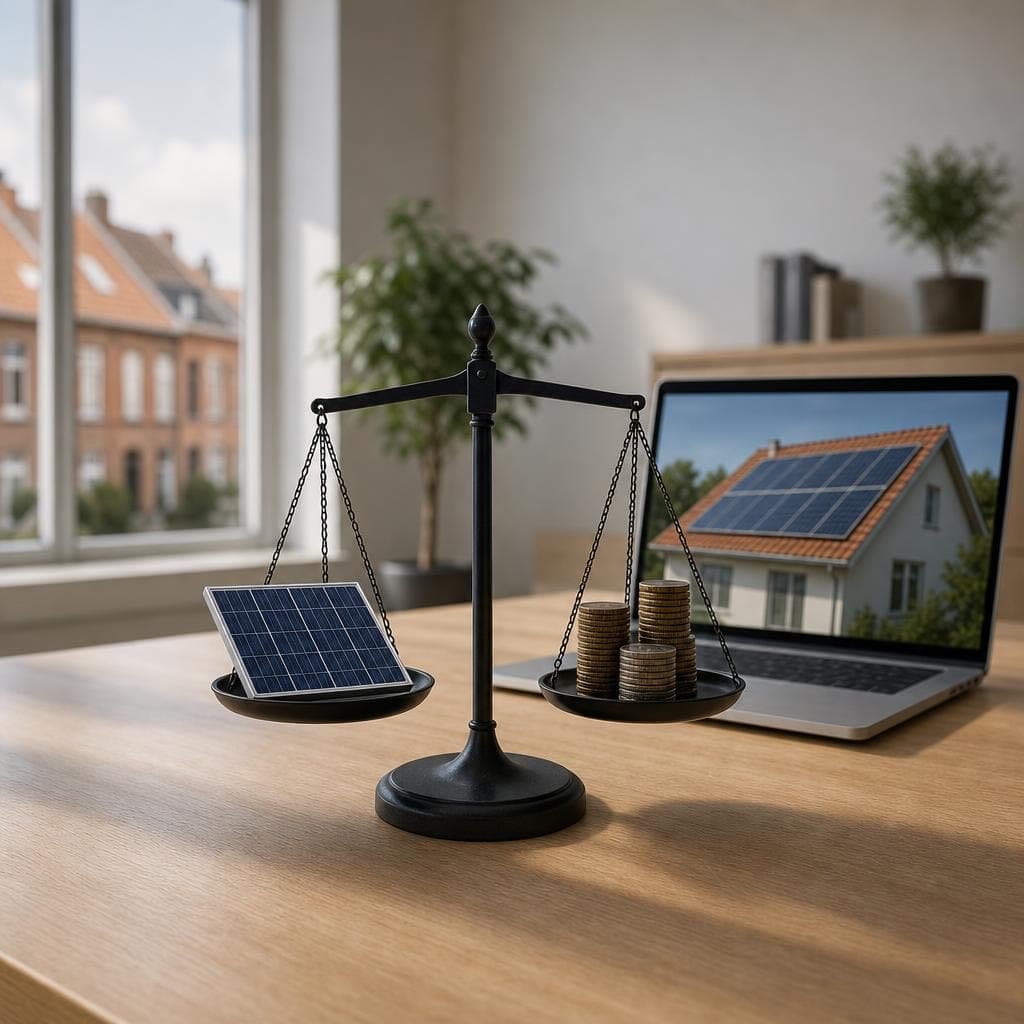
Production Guarantee vs Savings Guarantee
When you compare solar proposals, the phrase that sounds safest is not always the one that protects you best. A production guarantee and a savings guarantee both aim to reduce uncertainty, but they cover very different outcomes. One is tied to how much electricity a system produces. The other is tied to how much money you are expected to save. That difference matters because energy production is easier to model, measure, and verify than long-term utility savings, which depend on changing rates, usage patterns, and policy details.
If you want to understand which solar guarantee gives you clearer accountability, this guide breaks down what each one means, how each is measured, where the risks sit, and what questions you should ask before you sign a contract.
What is a production guarantee in solar?
A production guarantee is a commitment that a solar system will generate at least a stated amount of electricity over a defined period. That output is usually expressed in kilowatt-hours, such as annual production or cumulative production over multiple years. If the system underperforms relative to the guaranteed threshold, the provider may owe a remedy such as a financial credit, system corrections, additional equipment, or service work.
This type of guarantee focuses on energy output, not your utility bill. In other words, it answers the question: “Will this system generate the amount of electricity it was designed to produce?”
Because solar production can be tracked through monitoring platforms and inverter data, a production guarantee is generally more concrete than broader financial promises. It can also be tied to system design assumptions such as roof orientation, shading, local irradiance, equipment efficiency, and expected degradation over time.
What is a savings guarantee in solar?
A savings guarantee is a promise related to financial outcome rather than raw energy output. Instead of guaranteeing that the system will produce a certain number of kilowatt-hours, it guarantees that you will save a certain amount of money, reduce your bill by a certain percentage, or reach a projected level of economic benefit over a set term.
That sounds simple, but solar savings are influenced by more than system performance alone. Your actual savings can change based on electricity rates, time-of-use pricing, net metering rules, utility fee changes, seasonal usage, electrification upgrades, battery behavior, and how much of your solar power you self-consume.
For credible bill forecasts, see modeling TOU and demand charges in proposals.
So while a savings guarantee may be attractive from a homeowner or commercial buyer perspective, it is often built on assumptions that can shift over time. That makes it harder to validate and harder to compare across providers unless the terms are extremely specific.
Production guarantee vs savings guarantee: the core difference
The simplest way to compare the two is this: a production guarantee covers system output, while a savings guarantee covers financial result.
| Guarantee type | What it covers | How it is measured | Main variables | Typical risk |
|---|---|---|---|---|
| Production guarantee | Energy generation | kWh produced over time | Sunlight, shading, design, equipment, downtime | Underperformance of the solar system |
| Savings guarantee | Financial outcome | Bill reduction or dollar savings | Production plus utility rates, usage, tariffs, policy | Projected savings do not materialize |
In practice, that means production guarantees are usually more direct and easier to audit. Savings guarantees can still be useful, but only when the contract defines exactly how savings are calculated, which utility assumptions are locked in, and what happens if the customer’s energy use changes significantly.
Why production guarantees are usually easier to verify
Production is a physical system outcome. If your system was expected to generate 12,000 kWh over a year, monitoring data can show whether it actually did. That makes disputes more straightforward. The installer, developer, or platform can compare actual output against the guaranteed benchmark and evaluate whether corrective action or compensation is due.
Savings are more difficult because they involve multiple moving parts outside the solar array itself. A customer may install an EV charger, switch to a different rate plan, add electric heating, work from home more often, or face new utility charges. Even if the solar system performs exactly as designed, the financial result may differ from the original estimate.
That is why many solar professionals consider production guarantees more defensible than savings guarantees. They are based on a narrower set of measurable variables and do not rely as heavily on future assumptions that can change.
When a savings guarantee can still be useful
A savings guarantee can be valuable when the buyer cares most about budget certainty rather than technical system output. This is especially relevant in commercial solar, energy-as-a-service models, or financing structures where the real question is not how many kilowatt-hours the system makes, but whether the project delivers the promised economic return.
A strong savings guarantee works best when the contract clearly defines:
- the baseline utility bill or consumption model used
- the utility tariff assumptions
- whether future rate escalation is fixed or variable
- how self-consumption and exports are valued
- what happens if the customer materially changes usage
- whether taxes, fixed charges, and policy changes are included or excluded
For context on how financing affects guarantee framing and measurement, see cash vs loan vs PPA—how to present solar financing.
Without that level of detail, a savings guarantee can be more marketing-friendly than operationally reliable.
What affects solar production the most?
Searches around solar production guarantees often overlap with a basic question: what actually causes a system to produce more or less energy? That matters because a guarantee is only as credible as the assumptions behind it.
The biggest production drivers usually include:
- roof orientation and tilt
- shade from trees, chimneys, neighboring buildings, or seasonal obstructions
- panel efficiency and module quality
- inverter performance and system losses
- local irradiance and weather patterns
- soiling, snow, and maintenance conditions
- downtime from faults, communication failures, or delayed service
- normal module degradation over time
Because these variables can be modeled and monitored with reasonable accuracy, they fit naturally into a production-based guarantee framework. Better upfront analysis of solar access and TSRF also helps establish more credible output assumptions. If you need a refresher, read calculate solar access and TSRF.
What affects solar savings the most?
Savings depend on production, but they go beyond it. Two systems with identical output can create different savings if the utility structure or usage profile is different.
Key savings variables include:
- local electricity rates
- time-of-use pricing
- net billing and NEM 3.0
- fixed utility charges that solar cannot offset
- changes in household or business consumption
- battery dispatch behavior
- rate class changes for commercial customers
- policy or tariff changes over the life of the system
For a deeper dive into how export credits drive savings, read explain net billing (NEM 3.0) in proposals.
This is the main reason savings guarantees are harder to standardize. A provider may control the design of the array, but not the future path of electricity pricing or the customer’s evolving load profile.
Which guarantee is better for homeowners?
For most homeowners, a production guarantee is usually the clearer and safer benchmark because it is measurable and easier to enforce. It tells you whether the installer’s design assumptions were sound and whether the system is doing the job it was sold to do.
A savings guarantee can still be appealing if your priority is monthly affordability, but you should read it carefully. If the savings model depends on aggressive utility inflation assumptions or stable household behavior over many years, the headline number may look more certain than it really is.
If you are choosing between the two, ask yourself what you need most:
- If you want technical accountability, prioritize a production guarantee.
- If you want financial planning support, review a savings guarantee in detail and check every assumption.
- If possible, compare both against a transparent solar production simulation and a property-specific savings estimate.
Which guarantee is better for commercial solar?
In commercial projects, the answer depends on the deal structure. Production guarantees are often preferred in EPC, asset ownership, and performance monitoring contexts because they tie directly to system operation. Savings guarantees may be more relevant in managed energy contracts, service agreements, or projects where procurement teams focus on financial outcomes rather than equipment performance.
Commercial buyers should be especially careful about baseline assumptions. If operating hours, occupancy, equipment loads, or tariff structures change after installation, a savings guarantee can become difficult to interpret. In those cases, measured production is often the cleaner performance metric.
How production guarantees are typically structured
Not every provider uses the same framework, but most production guarantees include the same building blocks:
- Guaranteed output level, often annual or cumulative kWh
- Contract term, such as 1 year, 2 years, 10 years, or longer
- Measurement method using inverter or monitoring platform data
- Performance threshold before a claim applies
- Exclusions such as force majeure, customer-caused downtime, or unapproved system changes
- Remedy such as payment per missing kWh, repair work, or additional equipment
The strongest versions also define the weather dataset used for modeling, acceptable downtime thresholds, maintenance responsibilities, and the timeline for resolving underperformance.
How savings guarantees are typically structured
A savings guarantee usually requires more contract language because there are more assumptions to manage. You may see items such as:
- baseline utility cost before solar
- projected annual bill savings
- assumed utility escalation rate
- expected solar self-consumption versus export ratio
- treatment of fixed charges and non-bypassable fees
- rules for material changes in building use or occupancy
- true-up period for calculating shortfalls
If any of these items are vague, the guarantee becomes harder to trust. A savings guarantee should never be judged on the headline percentage alone.
Example: why production and savings can tell different stories
Imagine a solar system is projected to produce 10,000 kWh per year. The provider offers a production guarantee based on 95% of that figure, so the guaranteed minimum is 9,500 kWh.
Now imagine the system actually produces 9,700 kWh. The production guarantee has been met. But the homeowner still saves less than expected because the utility changed export credits, fixed charges increased, and the household started using more evening electricity after buying an EV. In that case, the system performed well, yet the savings outcome still fell short of the original estimate.
The reverse can also happen. A system may slightly miss its production target, but the customer still saves more money than expected because electricity rates rose faster than modeled. That is why production and savings should not be treated as interchangeable promises.
Where Enervio fits into this topic
Enervio is not positioned as a provider of a formal production guarantee or savings guarantee. Based on its public positioning, the platform supports solar installers and vendors with faster, more accurate quoting through tools such as remote property data collection, 3D solar simulations, production modeling, and property-specific solar savings estimates.
That distinction matters. A reliable guarantee starts with reliable assumptions. If you want to reduce disputes around expected output or projected savings, the quality of the original design and estimate is critical. Better geometry, shade analysis, production simulation, and proposal accuracy can strengthen the foundation on which future performance expectations are built.
In other words, even when no explicit guarantee is offered, a more robust solar production model and a better savings estimate can help installers set realistic expectations from the start.
Questions to ask before trusting any solar guarantee
Whether you are reviewing a production guarantee or a savings guarantee, ask these questions before you sign:
- What exactly is being guaranteed: kWh production or dollar savings?
- Over what period is performance measured?
- What data source is used to verify results?
- Which assumptions are fixed, and which can change?
- Who is responsible for maintenance and monitoring?
- What exclusions apply during weather events, outages, or property changes?
- What remedy is provided if the guarantee is missed?
- How quickly is a claim reviewed and resolved?
- Does the guarantee transfer if the property is sold?
- Is the guarantee backed by the installer, manufacturer, financier, or another entity?
Production guarantee vs warranty: not the same thing
This is one of the most common points of confusion. A production guarantee is not the same as a product warranty or workmanship warranty.
| Term | What it covers |
|---|---|
| Production guarantee | How much electricity the system generates |
| Savings guarantee | How much money the system is expected to save |
| Product warranty | Defects in panels, inverters, batteries, or other equipment |
| Workmanship warranty | Installation quality and labor-related defects |
You may need all of these protections, but they solve different problems. A system can be covered by strong equipment warranties and still fail to meet expected production if the design assumptions were poor.
How to compare solar proposals more accurately
If two solar proposals look similar, the safest approach is to compare both the projected production and the projected savings, then check how each provider documents assumptions.
Focus on these items:
- annual and cumulative production estimate
- shade assumptions and roof layout quality
- weather and irradiance dataset used
- degradation assumptions over time
- utility tariff inputs in the savings estimate
- clear separation between estimate and guarantee
- monitoring capabilities after installation
- service process if actual results differ from projections
A good solar proposal does not hide uncertainty. It explains it clearly and shows which outcomes are modeled, which are guaranteed, and which depend on future variables. For teams documenting those assumptions clearly, see solar proposal templates and best practices.
FAQ
What is a production guarantee?
A production guarantee is a commitment that a solar system will generate a minimum amount of electricity over a defined period. It is typically measured in kilowatt-hours and verified through monitoring data.
What is a savings guarantee?
A savings guarantee is a promise tied to financial outcome, such as bill reduction or total dollar savings. It depends on system performance plus utility rates, tariffs, and customer energy use.
Is a production guarantee better than a savings guarantee?
It is usually easier to verify and enforce because it is tied to measured energy output. Whether it is better depends on your goal, but it is generally the clearer form of accountability.
Can a solar system meet its production guarantee but miss savings expectations?
Yes. If utility rates, export credits, fixed charges, or your usage pattern change, your financial savings can differ even when production stays on target.
Can a system miss its production target and still save money?
Yes. If electricity prices rise faster than expected or your rate structure becomes more favorable, your actual savings may still be strong despite slightly lower production.
Do all solar installers offer a production guarantee?
No. Some offer only production estimates, while others provide formal guarantees with defined remedies and exclusions. You should always ask for the exact contract language.
Do all solar savings estimates count as a savings guarantee?
No. Many proposals include projected savings, but that does not mean the installer is contractually guaranteeing those results. An estimate and a guarantee are not the same thing.
How can you improve confidence in production and savings estimates?
Confidence improves when the proposal is based on strong remote data, accurate shade analysis, realistic solar simulation, and property-specific assumptions rather than generic averages. That also depends on modeling time-of-use and demand charges correctly when projecting bill outcomes.


