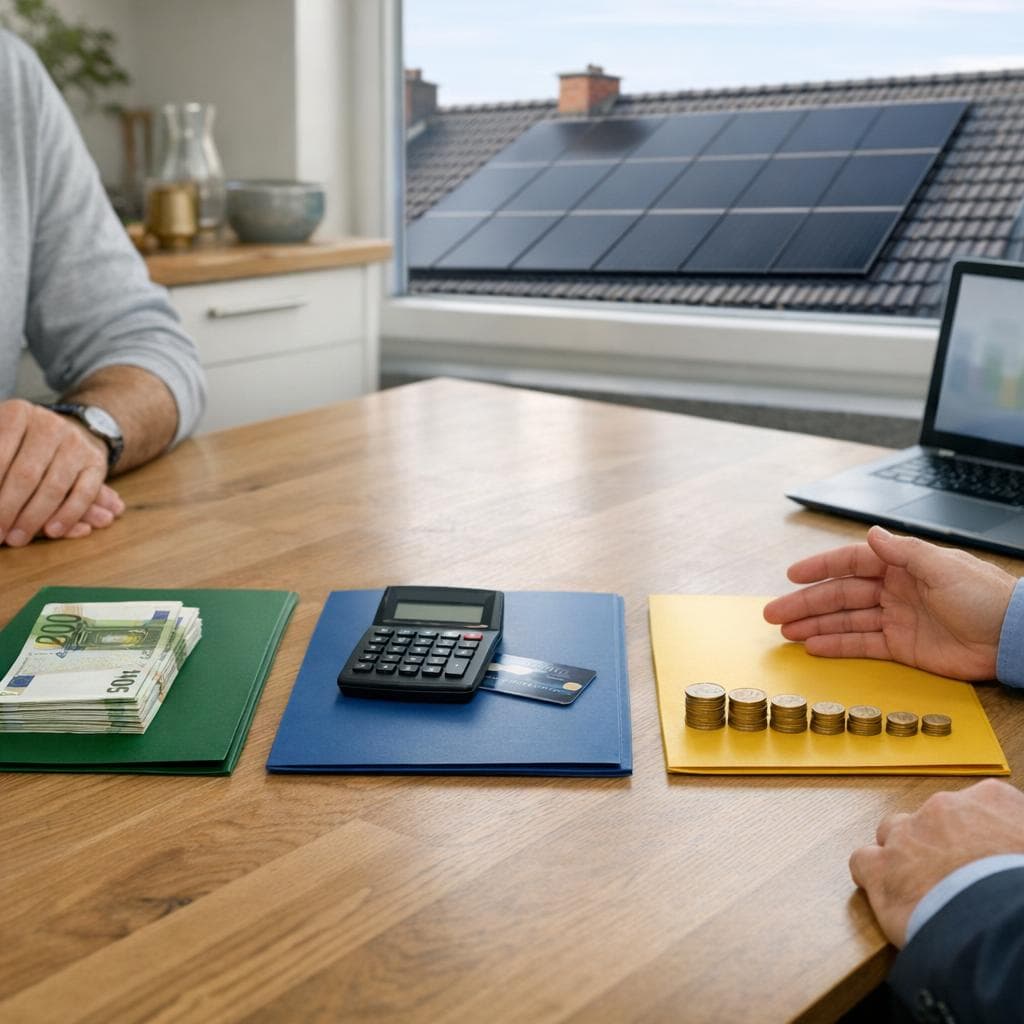
The way you pay for solar changes everything you spend and everything you get. Cash, a solar loan, or a PPA/lease each shifts who owns the system, who claims incentives, how much you pay over time, and how predictable your bills are. Use this guide to decode quotes, spot dealer fees and escalators, and choose the option that fits your goals and cash flow. For a sales-ready walkthrough, see How to explain solar financing options to homeowners.
How financing changes your total cost
Every solar quote boils down to a few drivers: the system price, incentives you can claim, the cost of money, and the payment structure. Paying cash is simple – you pay the net price after incentives and avoid interest. A loan spreads payments but adds interest and often a dealer or origination fee that can add 10-30% to the financed amount. A PPA or lease charges for power or service over a long contract and may include an annual price escalator. Ownership also dictates responsibilities: owners handle out-of-warranty maintenance, while PPA/lease providers typically include it. The same equipment can have very different lifetime costs depending on these levers, so always compare line items side by side. You can make these trade-offs tangible by customizing solar proposals with 3D visuals.
Paying cash
Direct ownership and ROI
With cash you own the system on day one, capture available incentives yourself, and avoid interest. That typically delivers the lowest lifetime cost and the highest net present value. Your payback depends on system price, sun exposure, energy rates, and net metering rules, but many homeowners see simple paybacks in the 6-10 year range. If you have the liquidity and tax liability to use the available credit in your market, paying cash is the benchmark other options must beat. The trade-off is tying up capital that might have alternative uses.
What to check in a cash quote
Confirm the cash price per watt, equipment makes and warranties, labor and permitting, and that incentives are calculated correctly. Ask for production estimates and any performance guarantees. You will be responsible for maintenance outside warranty periods, so review inverter and roof workmanship terms and their durations.
Solar loans
Interest and lifetime cost
Loans let you own the system without paying the full amount upfront. Your total outlay is the principal plus interest across the term, commonly 10-25 years. Shorter terms raise monthly payments but cut interest paid. Rates vary by credit profile and product type. Home equity loans or HELOCs can offer lower rates but are secured by your home. Always request an amortization schedule and the all-in APR so you can compare apples to apples.
Dealer and origination fees explained
Many “0% APR” or low-rate solar loans hide costs in a dealer or origination fee added to the financed amount. Example: a $20,000 system with a 25% dealer fee becomes $25,000 financed. Even at 0% APR, you are repaying more than the cash price. Other loans show an explicit APR plus a smaller fee. To compare fairly, ask for the cash price, the financed price, the fee as a dollar amount and percentage, the APR, the term, prepayment rules, and whether you are expected to make a lump-sum payment when you receive any tax credit. Small differences in fees and terms can swing lifetime cost more than the interest rate alone.
Ownership and incentives with a loan
You own the system and typically claim incentives if you qualify. Some loans are structured with an expected paydown equal to your tax credit – understand if that is required and whether there are prepayment penalties. Maintenance responsibilities remain with you, just as with cash.
PPAs and leases
How PPAs and leases work
With a power purchase agreement you do not buy panels – you agree to buy the electricity they produce at a set price per kWh. A lease is similar but usually charges a fixed monthly fee for the equipment’s use. A third party owns, operates, and maintains the system, so there is typically little or no upfront cost and maintenance is included. The provider usually takes available incentives. Contracts often last 15-25 years and may include an annual price escalator. These models can offer immediate bill savings and simplicity if you cannot use tax credits or prefer a service approach, but you trade away ownership and must review transfer or buyout terms carefully.
How to read a PPA or lease offer
Focus on the economics and the fine print you will live with for years:
- Price today – the kWh rate for a PPA or the flat monthly lease amount.
- Annual escalator – typical 0-3% per year. Understand its effect on year 10 and beyond.
- Production or uptime guarantee – what happens if output misses the estimate.
- Term length and end-of-term options – renewal, buyout formula, or removal.
- Incentives – who receives tax credits and rebates.
- Service scope – what maintenance is included, response times, monitoring.
- Roof work and relocation – costs for removal and reinstallation if you reroof or move.
- Sale or early termination – transfer requirements and any fees if you sell your home.
To stress-test escalators and long-term savings, run side-by-side scenarios before you sign. During discovery, use these solar site survey template questions to surface financing preferences and risks early.
Cash vs loan vs PPA – quick comparison
Use this high-level snapshot before you run the math on your quotes.
| Factor | Cash | Loan | PPA/Lease |
|---|---|---|---|
| Ownership | You | You | Provider |
| Upfront cost | Highest | Low to moderate | Low to none |
| Monthly payments | None | Fixed loan payment | Per kWh or flat lease |
| Who gets incentives | You | You | Provider |
| Lifetime cost | Lowest | Higher – interest and fees | Varies – escalators matter |
| Maintenance | You | You | Included |
| Contract length | None | Loan term | 15-25 years typical |
| Best fit | Max savings, high liquidity | Ownership with manageable cash flow | No upfront, prefer service model |
Choosing the right option for your goals
If you want the lowest lifetime cost and can use available incentives, cash is hard to beat. If you prefer to preserve cash but still want ownership, target a loan with a competitive APR, minimal dealer fee, no prepayment penalty, and a term that keeps monthly savings positive against your current utility bill. If you want little to no upfront cost and bundled maintenance, or you cannot use tax credits, a PPA or lease can deliver predictable savings – just stress test the escalator and transfer terms. In all cases, compare the cash price, financed price including all fees, and any PPA rate path against your utility’s rate outlook. Installers using Enervio generate transparent, line-item quotes you can compare in minutes so you can pick cash vs loan vs PPA with confidence. For sales teams, sharpen your messaging with value propositions that convert solar leads. If you tailor financing by segment, see solar buyer personas and messaging.
FAQs
Is PPA or loan better for solar?
Neither is universally better. If you qualify for incentives and can secure a low-rate, low-fee loan, ownership often wins on lifetime cost. A PPA can be better if you want no upfront cost, included maintenance, and immediate bill savings with limited responsibility. Compare net monthly savings and total 20-25 year cost side by side.
What is the 33% rule in solar panels?
People often mean the Shockley-Queisser limit, a physics concept that puts a theoretical efficiency ceiling of about 33% on single-junction solar cells. It is not a financing rule and does not decide between cash, a loan, or a PPA.
What is the 20% rule for solar?
There is no universal 20% financing rule. Some use 20% to describe typical panel efficiency or a suggested down payment, but lenders and offers vary widely. For financing, focus on the all-in APR, dealer fee, term, and prepayment terms. For PPAs, focus on the starting rate and escalator.
Is PPA solar cheaper than owning?
Month one, a PPA can be cheaper because there is no upfront cost and maintenance is included. Over 20-25 years, owning with cash or a low-fee loan is usually cheaper, especially if you can use incentives. Run the numbers with the PPA escalator and your utility’s rate outlook before deciding.


