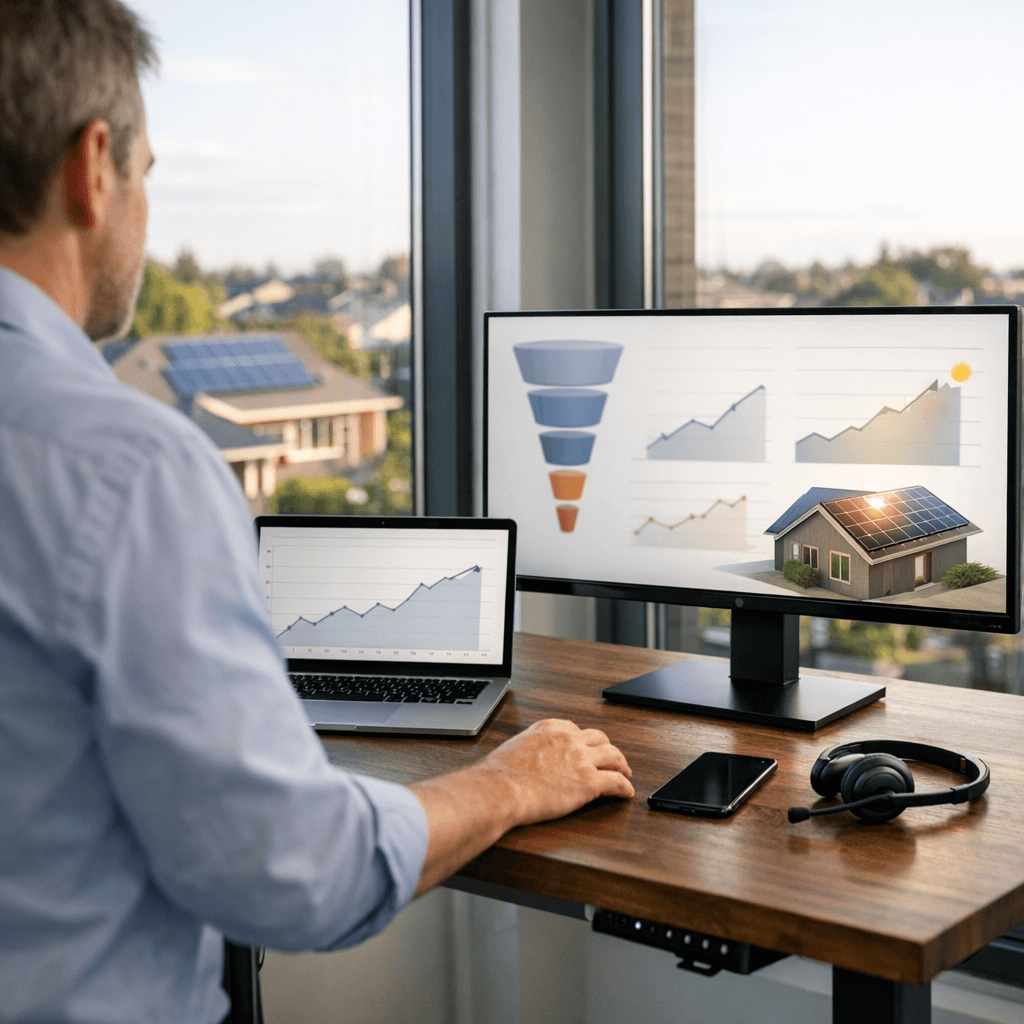
Your pipeline is only as valuable as the revenue it creates. Solar lead generation ROI tells you whether your budget is turning interest into installs at a profit. The biggest levers are lead quality and intent, speed-to-lead, follow-up, and the efficiency of your sales process. This guide shows you what moves the numbers, how to measure return with confidence, and where AI-driven workflows from Enervio.io can cut costs and lift conversion without adding headcount. If you need a quick primer, see what is solar lead generation.
What is solar lead generation ROI?
Solar lead generation ROI is the return you get from your marketing and lead-buying efforts relative to what you spend. In simple terms, it compares closed-won revenue against your total lead gen costs to show profitability. You should include media spend, third-party lead purchases, software, and labor used to generate and convert leads. A practical way to look at it is through customer acquisition cost versus average deal value and margin. When your cost to acquire a customer drops and your close rate rises, your solar lead generation ROI improves.
Lead types, quality, and intent: where ROI is won or lost
Not all solar leads are created equal. Exclusive leads are sold to one installer, so you avoid bidding wars and contact fatigue. They usually cost more per lead but convert at higher rates because the homeowner’s experience is consistent and you control the follow-up. Shared leads are cheaper, yet you compete with multiple installers and response time must be near instant to win the conversation. Appointment-set leads include a scheduled call or site assessment and can deliver strong ROI if the qualification criteria are strict and honored.
Live transfer leads connect you to a prospect in real time once intent is verified. You pay a premium, but you skip voicemail tag and achieve higher connect and qualification rates. Across all types, intent signals matter most. Form submissions with clear motivation, accurate property details, and permission to contact typically beat broad list buys or cold outreach. Matching lead type to your team’s strengths is critical. If you excel at rapid responses and tight scripting, shared or live transfers can work. If your process is consultative and you nurture well, exclusive and appointment leads often maximize ROI.
Cost and CAC drivers you can control
Your cost per lead and customer acquisition cost vary by geography, channel, and volume. Competitive states with mature incentives tend to push prices up, while underdeveloped regions can be cheaper but convert less without education. Channel mix matters too. Organic and SEO leads often carry lower CPL but require time and content investment. Paid search and social bring speed with higher CPL but can scale predictably. Referral and partner leads are cost-effective when you track attribution. Buying too much volume outside your service area or ideal home profile inflates cost and drags down ROI. Need a formula? calculate your solar cost per lead (CPL).
Operational levers that move ROI now
Speed-to-lead
Respond to each new lead in under 60 seconds to maximize connects and booked appointments. After 5 minutes, connect and qualification rates drop sharply. Route leads instantly, use caller ID that references solar, and open with a clear value promise tied to the homeowner’s intent. Even small gains in connect rates compound downstream into lower CAC and higher ROI. For tactics that raise close rates and lower CAC, see speed to lead and lead routing.
Follow-up and nurturing
Most solar buyers research for weeks. Build a 14 to 21 day cadence that mixes calls, SMS, and email, then continue light-touch education for 60 to 90 days. Use short messages that reaffirm savings potential, incentives by state, and next steps to estimate system size. Log outcomes per touch so you can prune low-value steps and double down on messages that drive appointments.
CRM and automation
Track every lead, touch, and stage in your CRM. Automate the first response, appointment reminders, document collection, and proposal follow-ups. Score leads by property fit and intent so reps prioritize the highest probability opportunities. Automation reduces manual work, shortens cycle time, and preserves consistency, all of which improve solar lead generation ROI. Selecting the right stack further boosts results; consider integrating solar sales software with your CRM.
Measure ROI with a simple model
Start with a clear funnel: leads, contacted, qualified, appointments set, proposals delivered, closed-won. Record cost per lead and calculate conversion at each step. For stage definitions and benchmarks, review the solar lead generation funnel. Your customer acquisition cost equals your total lead gen and sales expense for a period divided by customers won. ROI can be expressed as net revenue divided by total cost. For example, if you spend 10,000, close 10 systems at an average 2,500 gross margin per system, your margin is 25,000 and your ROI is 2.5. Track payback period and lifetime value to understand cash cycles and long-term profitability.
How Enervio.io improves your ROI
Enervio.io accelerates your sales process so you convert more of the leads you already have. Remote property data collection removes many site visits, cutting acquisition costs and scheduling delays. A personalized AI educational agent answers questions with state-specific guidance, increasing homeowner confidence and qualification rates. One-click quotes and 3D solar simulations let you generate accurate proposals in minutes instead of a day, which boosts speed-to-proposal and win rates. The platform integrates with your existing stack, automates follow-ups, and makes attribution clearer, helping you scale solar lead generation ROI without adding overhead. If you’re planning your rollout, implement solar sales software to maximize process efficiency and ROI.
FAQs about solar lead generation ROI
What is the ROI of lead generation?
It is the profit you generate from marketing and lead-buying activities relative to what you spend. Measure it by tying closed-won revenue and gross margin back to campaign and vendor costs, including software and labor. Improve ROI by lifting conversion at each stage, reducing cost per lead, shortening cycle time, and focusing on high-intent segments that match your ideal customer profile.
Are solar leads worth it?
They are when quality, intent, and process align. Exclusive and live transfer leads often convert best, but shared and appointment leads can deliver strong results if you respond fast and qualify consistently. Track CAC, close rate, and margin by lead source for 60 to 90 days. Keep sources that deliver profitable installs and cut those that inflate cost or waste rep time.
Is lead generation profitable?
Yes, if you control acquisition cost and sustain healthy close rates. Profitability improves when you narrow targeting, remove friction in scheduling and proposals, and automate routine tasks. Over time, owned channels like SEO and referrals typically compound profitability, while paid channels provide predictable scale when managed with tight attribution and creative testing.
Next steps to lift your ROI
Audit your funnel for speed-to-lead, consistent follow-up, and proposal turnaround. Trim sources that underperform on CAC and reinvest in high-intent segments. If you’re evaluating tooling, compare solar sales platforms feature by feature to understand which capabilities move ROI. If you want to convert more leads without hiring more coordinators, see how Enervio.io streamlines education, quoting, and proposals in minutes. Book a demo to understand the fastest path to a higher solar lead generation ROI.


