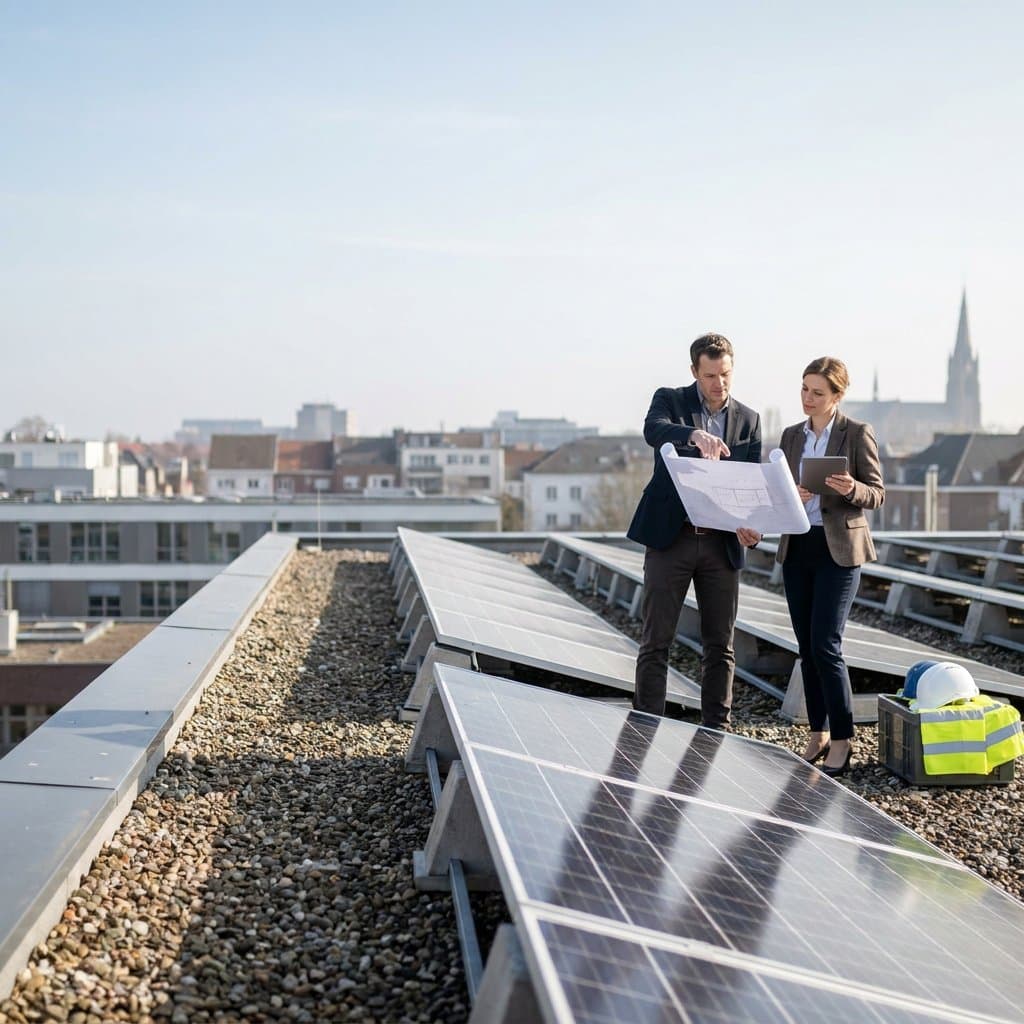
Commercial solar panel sales
Commercial solar sales are rarely won on panel count alone. Serious buyers want to know whether a system is technically viable, what it will save, how quickly it pays back, how much disruption it creates, and how it will perform over the long term. The strongest opportunities are built on real site and usage data, with finance structure, grid or planning constraints, and future expansion discussed early. Because most commercial projects need sign-off from more than one stakeholder, deals also move faster when finance, operations, property, and sustainability questions are answered separately rather than buried inside one generic proposal.
What commercial buyers are really evaluating
In commercial solar panel sales, the product is not a commodity purchase. It is a site-specific energy investment, so buyers look first at roof or ground fit, structural condition, daytime load, export limits, and the likely operating life of the system. Panel count matters far less than whether the design matches how the business actually uses power.
The commercial case usually combines lower electricity spend, more predictable energy costs, and progress on carbon, ESG, or building-performance targets. That is why serious buyers expect feasibility work and ROI modelling before installation, including modeling time-of-use and demand charges in proposals, with assumptions tied to real consumption and realistic output. In many projects, storage, EV charging, monitoring, or other efficiency measures also shape the final scope.
Who signs off the deal – and what each stakeholder needs to see
| Stakeholder | Main concern | What they need to see |
|---|---|---|
| Finance | Payback, monthly cash impact, ownership model, tax or accounting implications | Clear cash-flow assumptions, finance routes, and realistic ROI sensitivity |
| Facilities and operations | Roof condition, structure, downtime, maintenance, planning or grid handling | Survey scope, installation phasing, safety planning, and support expectations |
| Sustainability, property, and estates | Carbon outcomes, EPC impact, lease or landlord constraints, wider asset strategy | Property-fit evidence and a clear link to estate or reporting goals |
| Procurement and legal | Accreditations, warranties, monitoring scope, liability, and accountability | Contract clarity, health and safety evidence, and defined post-commissioning responsibility |
To turn stakeholder concerns into approval-ready documents that speak to CFO and COO priorities as well as the wider buying committee, see commercial solar proposal software.
Where commercial solar is usually the easiest sell
Commercial solar is usually easiest to sell where self-consumption is strong and the site can physically support the system.
- Industrial and warehouse sites: large roof areas, steady daytime demand, and rising electricity costs make savings easier to prove.
- Schools and public-sector buildings: daytime use aligns well with solar output, while carbon reporting and educational value often strengthen the case.
- Farms and rural estates: barns, sheds, pumping, refrigeration, and other daytime loads create a practical fit, especially when land is available.
- Energy-intensive commercial premises: manufacturing, cold storage, leisure, and similar sites can show strong returns when grid use is expensive.
- Offices, retail, hospitality, healthcare, and landlord-held buildings: the message often shifts from pure savings to resilience, asset performance, ESG visibility, or support for EV fleets.
How pricing, payback, and finance change the conversation
| Commercial issue | How it affects the sale |
|---|---|
| Per-panel pricing | When buyers ask about commercial solar panels for sale or ask, “How much can I sell a solar panel for?”, the practical answer is that commercial systems are rarely sold as simple per-panel stock. They are priced as engineered projects. |
| What sets total cost | System size matters, but so do roof or ground mounting, access, electrical upgrades, structural work, grid connection requirements, storage, and monitoring scope. |
| Why similar systems price differently | Two sites with the same DC capacity can have very different costs if one needs more complex cable runs, switchgear work, export controls, or restricted installation access. |
| What drives payback | Returns depend heavily on on-site consumption, tariff structure, export value, load timing, and expected lifetime output. Faster payback usually comes from strong daytime demand, not just cheaper equipment. |
| Finance route | Cash or capex, loans or hire purchase, lease or rental, and PPAs all change ownership, monthly cash flow, balance-sheet impact, and the objections that appear during approval. |
| Tax and accounting | Capital-allowance and accounting treatment can influence sign-off, so proposals should flag likely considerations and direct buyers to their tax or finance advisers for confirmation. |
What a credible commercial solar sales process looks like
A serious commercial solar sale should feel more like due diligence than a quick retail quote. For a step-by-step overview, see commercial solar sales process. A practical process usually includes:
- Initial qualification using bills, interval data, operating hours, site details, the internal buying group, and appropriate lead qualification frameworks (BANT) for solar.
- Technical assessment covering roof condition, structure, shading, electrical capacity, and any interconnection or DNO constraints.
- Design optimisation that tests system size, export limitation, battery-readiness, and realistic savings assumptions before contracts are signed.
- Delivery planning for surveys, approvals, installation phasing, commissioning, and disruption control.
- Post-live support covering monitoring, alerts, maintenance, and clear escalation after handover.
For solar companies, this is also where an integrated workflow helps. Enervio is built around commercial solar lead generation, automation, landing pages, and property insights so teams can qualify better and follow up more consistently on complex deals.
What to collect before the first serious commercial solar call
- Recent electricity bills, interval or demand data, operating hours, and any planned load changes.
- Site details such as building type, roof age and condition, usable area, land availability, and ownership or lease status.
- The buying group, approval sequence, target decision timeline, and any relevant solar buyer personas and messaging needs.
- Priorities around storage, EV charging, backup power, EPC targets, and export versus self-consumption.
Commercial solar sales FAQs that remove friction
Once the headline business case looks viable, friction usually shifts to approvals, disruption, maintenance, future expansion, compliance outcomes, and supplier fit. These are the questions that should be clarified during discovery where possible, then confirmed through engineering, utility, tax, or legal review when needed.
Do you need planning permission or grid approval for a commercial solar project?
Sometimes yes, sometimes no. In the UK, many rooftop systems may fall within simplified permission routes, but listed buildings, unusual sites, and larger ground-mounted schemes often need fuller review. Grid or DNO approval is separate from planning and can affect export limits, connection timing, or design choices. Those issues should be surfaced early, not treated as post-sale admin.
How much disruption, maintenance, and aftercare should a buyer expect?
Most commercial installations can be phased around operating hours, with shutdown-sensitive tasks planned in advance. Ongoing maintenance is usually light, but buyers should still expect monitoring, periodic inspections, and occasional cleaning or component replacement over time. Aftercare matters because issue alerts, performance visibility, and response times help protect the ROI presented during the sale.
Can batteries, EV charging, or future expansion be added later?
Often yes, provided the original design leaves room for it. Many commercial systems are made battery-ready even if storage is added later. Batteries and EV charging become more attractive where evening demand, fleet charging, demand charges, or resilience needs are present. Expansion can affect inverter sizing, export controls, and the original business case, so it should be discussed upfront.
Do solar panels improve EPC and ESG reporting?
They can contribute, but the exact result depends on the property, the wider building fabric, and the methodology used for assessment. For many owners and occupiers, the ESG case is strongest when carbon reduction is quantified alongside projected utility savings. For landlords and multi-site operators, that can be nearly as important as the direct energy benefit. What should be avoided is any promise of a fixed EPC uplift without a proper property-specific assessment.
Are the biggest solar companies in the UK automatically the best fit?
No. Scale can suggest delivery capacity, but it does not guarantee the best commercial outcome for a specific site. A large brand is still the wrong choice if the proposal relies on weak load assumptions, overlooks roof or grid constraints, or leaves maintenance responsibility unclear.
A better comparison looks at relevant project experience, accreditations, design quality, finance flexibility, monitoring, planning and DNO capability, and who owns post-install support. Ask how the provider models self-consumption, what happens if export is constrained, how business disruption will be managed, and what reporting you receive after commissioning. For complex estates or multi-site rollouts, consistent delivery and reporting often matter more than headline brand recognition. The safest shortlist is not the biggest names by default; it is the providers that show site-specific thinking, realistic numbers, and clear accountability from survey through aftercare.
Is there any real market for used commercial solar panels?
There is a secondary market, but it is niche. Most commercial buyers prefer new, warranted modules inside a fully engineered system. When you see used commercial solar panels for sale, value depends on age, degradation, test data, certifications, compatibility, and removal and transport cost. Panels are often removed because of roof replacement, repowering, damage, or site changes, not because solar has no value.
What does the “20% rule” usually mean in commercial solar?
There is no single universal 20% rule in solar sales. In commercial projects, the phrase is often used loosely to describe backfeed or export constraints on existing electrical infrastructure. The real question is what the site’s distribution equipment and grid connection can support under local code and utility or DNO requirements. If a site is constrained, export limitation, system resizing, or storage can sometimes keep the project viable.