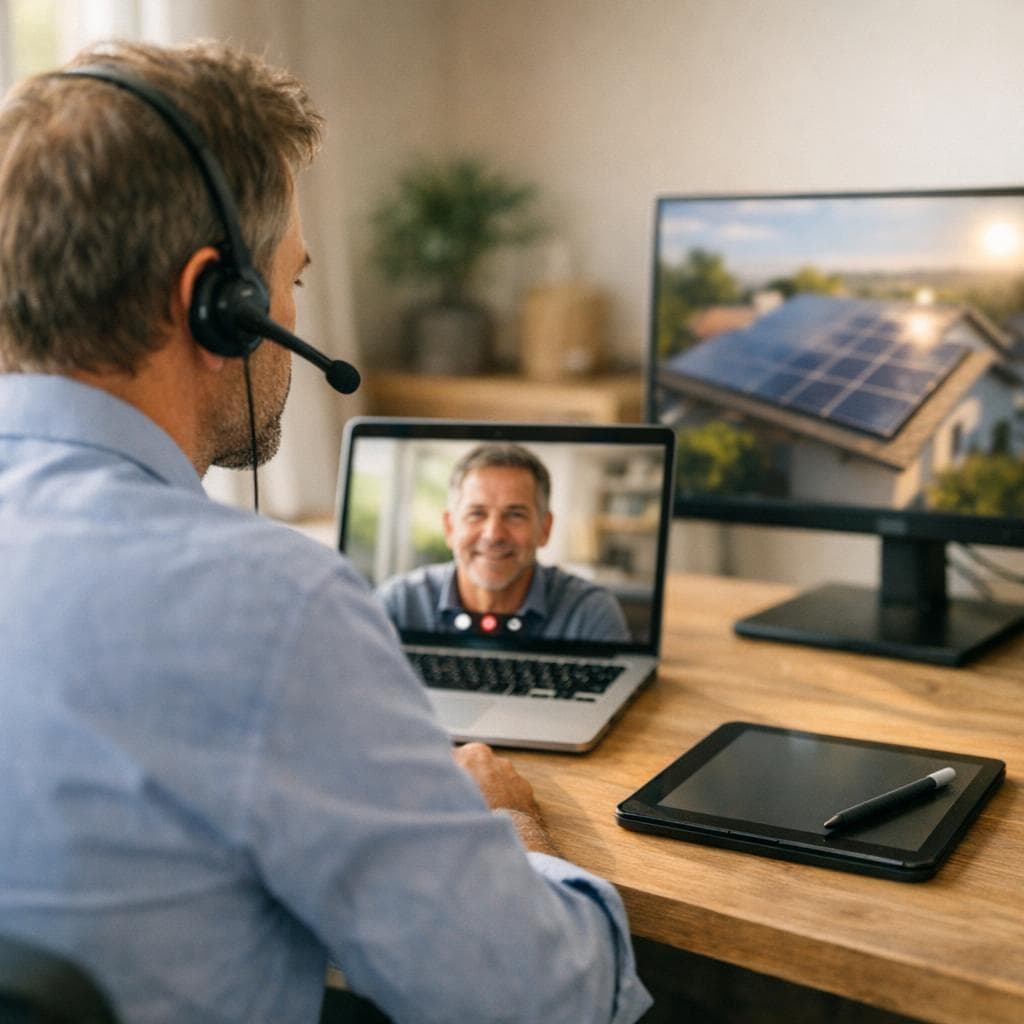
Speed wins in solar. Remote sales let you respond in minutes, educate prospects visually, design accurate systems without truck rolls, and e-sign on the spot. The result is a shorter cycle time, lower cost per sale, and a buying experience modern homeowners actually prefer. This step-by-step playbook shows you how to structure a high-converting remote solar sales process and where AI-driven tools like Enervio can remove friction end to end.
What is a remote solar sales process?
A remote solar sales process replaces travel and in-person site visits with digital touchpoints. You generate and qualify leads online, book a video call, share your screen to explain utility bills and incentives, co-design the array using aerial and LIDAR data, model savings and financing, then send an e-sign proposal for immediate approval. Field teams visit only after contract for final verification, which cuts pre-sale costs and accelerates time to close.
Build and activate your inbound engine
Lead capture that qualifies without friction
Embed a fast-loading form and calendar on your landing pages. Capture only what you need to qualify and personalize the proposal: address, utility, average bill or kWh, roof material, and preferred financing. Offer instant value to increase conversions, such as a savings estimate or a 3D roof preview generated from the address.
Speed to lead workflow
Respond in under 5 minutes. Use an auto-dial plus SMS and email sequence that confirms the appointment and shares a short explainer. Ask for a recent electricity bill and permission to use satellite imagery so you can pre-design. With Enervio, you can automate data collection, pull property attributes remotely, and generate a draft proposal before the call so your first meeting feels like a tailored consult, not a cold intro. Standardize remote triage with AI lead qualification for solar.
Run the remote sales call
An agenda that converts
Go into the call with a structured plan and discovery prompts. Prep using Questions to ask homeowners during a solar consultation.
- Set the agenda in 30 seconds – confirm goals, timing, and that you will review design, savings, and next steps.
- Diagnose the bill – screen share the customer’s utility bill, clarify rates, fees, and net metering status.
- Co-design the system – show a 3D roof, shade analysis, panel layout, and stringing logic. Adjust live to align with budget and aesthetics.
- Model the economics – present production, payback, incentives, and multiple financing paths side by side.
- Agree on scope – confirm system size, equipment, price, timeline, and any adders like main panel upgrades.
- Call to action – transition to e-sign and scheduling of post-sale site verification.
For a step-by-step consult workflow, see Run an AI-powered solar consultation.
Screen-sharing best practices
- Clarity over flash – zoom in on key numbers, use large fonts, and pause for confirmation.
- Use video intentionally – keep camera on for trust, but prioritize screen time for complex visuals like shade reports.
- Summarize each section – one-sentence recap before moving forward to maintain alignment.
Objection handling micro-plays
- Price – anchor on total ownership cost vs utility escalation, then show payment options that match monthly comfort.
- Accuracy without site visit – reference LIDAR heights and high-res imagery used for design, plus a post-sale verification step that protects the homeowner if adjustments are needed.
- Timing – tie incentives or rate changes to urgency and offer a conditional hold with e-sign to lock pricing.
With Enervio, you can walk prospects through AI-personalized education, 3D visualizations, and a one-click proposal inside the same flow, which removes context switching that often derails remote calls.
Close and contract digitally
Pricing and financing levers
Present 2 to 3 clear options only. Keep the system constant while varying payment method and term so decisions are about affordability, not scope confusion. Show the delta between options as monthly differences, not just totals. Use Solar proposal templates and best practices to raise clarity and close rates.
E-sign, scheduling, and compliance
Send the proposal live on the call and guide the customer to e-sign. Collect IDs and required disclosures in the same session. Confirm next milestones: site verification, final design stamp, interconnection, and install window. Enervio streamlines this handoff by auto-generating the proposal from your design and logging signed documents back to your CRM, so operations can start within minutes.
Your remote solar tech stack
You can stitch point tools together or use an all-in-one platform. Either way, cover these categories to remove friction from click to close.
- Lead capture and routing – forms, chat, and instant scheduling tied to round-robin rules.
- Solar design – 3D modeling with shade, LIDAR, equipment libraries, and loss factors.
- CPQ and proposals – pricing rules, incentives, financing integrations, dynamic proposals, e-sign.
- Video and calls – reliable conferencing, call recording, and screen sharing.
- CRM and automation – pipeline stages, SLAs for speed to lead, and multi-channel sequences.
For pipeline visibility and handoff discipline, implement a Solar CRM for lead management.
| Stage | Key tools | Must-have features | Example KPI |
|---|---|---|---|
| Lead capture | Form, chat, scheduler | Pre-fill address, calendar embed, routing | Form-to-appointment rate |
| Speed to lead | Dialer, SMS, CRM | 1-5 min SLAs, sequences, call recording | Contacted in 5 min |
| Design | 3D modeling | LIDAR, shade, equipment library | Design turnaround time |
| Proposal | CPQ, e-sign | Incentives, financing, one-click send | Proposal within 24 hours |
| Close | Video, e-sign | On-call signing, ID capture | Same-day close rate |
If you prefer an integrated approach, Enervio brings this stack together with remote property data capture, AI education, 3D visualization, one-click proposals, e-sign, and integrations. Scale and Enterprise plans include RFP credits and automations like Zapier workflows for Meta ads, so your team can go from lead to signed deal without switching screens.
Measure and optimize your funnel
- Speed metrics – time to first call, time to proposal.
- Conversion metrics – set rate, show rate, close rate, same-day close rate.
- Efficiency metrics – cycle time, cost per acquisition, no-show rate.
- Quality metrics – proposal acceptance by option, redesign rate after site verification.
Review call recordings weekly, A/B test your agenda and proposal layout, and enforce SLAs. Use Enervio analytics to spot friction points and trigger automations that keep deals moving. For attribution and ROI clarity across channels, follow How to track solar leads and attribution.
FAQs
How to sell solar remotely?
Make it fast and visual. Capture key inputs online, respond in minutes, pre-design with aerial and LIDAR data, run a video consult with clear screensharing, present 2 to 3 financing options, and e-sign on the call. Automate follow-ups and next steps so momentum never drops.
What are the 5 stages of the sales process?
Prospecting, qualification, presentation, negotiation, and closing. In remote solar, map them to capture, speed to lead, design and proposal, objection handling, and e-sign. Assign SLAs and KPIs to each stage to keep the pipeline predictable.
What is the 33% rule in solar panels?
There is no universal 33% rule in PV design. Some use the term informally to describe targets like limiting shading or roof coverage in specific contexts. Follow local codes, utility rules, and manufacturer specs rather than relying on a generic percentage.
How does remote sales work?
You replace travel with technology. Leads book online, you qualify and design using remote data, meet on video to co-create the solution, then send an e-sign proposal. Post-sale, you verify on site and proceed to permitting, interconnection, and install.
Want fewer handoffs and faster closes? Enervio unifies remote data capture, AI education, 3D design, proposals, and e-sign so you can turn interest into installs with less effort.


